





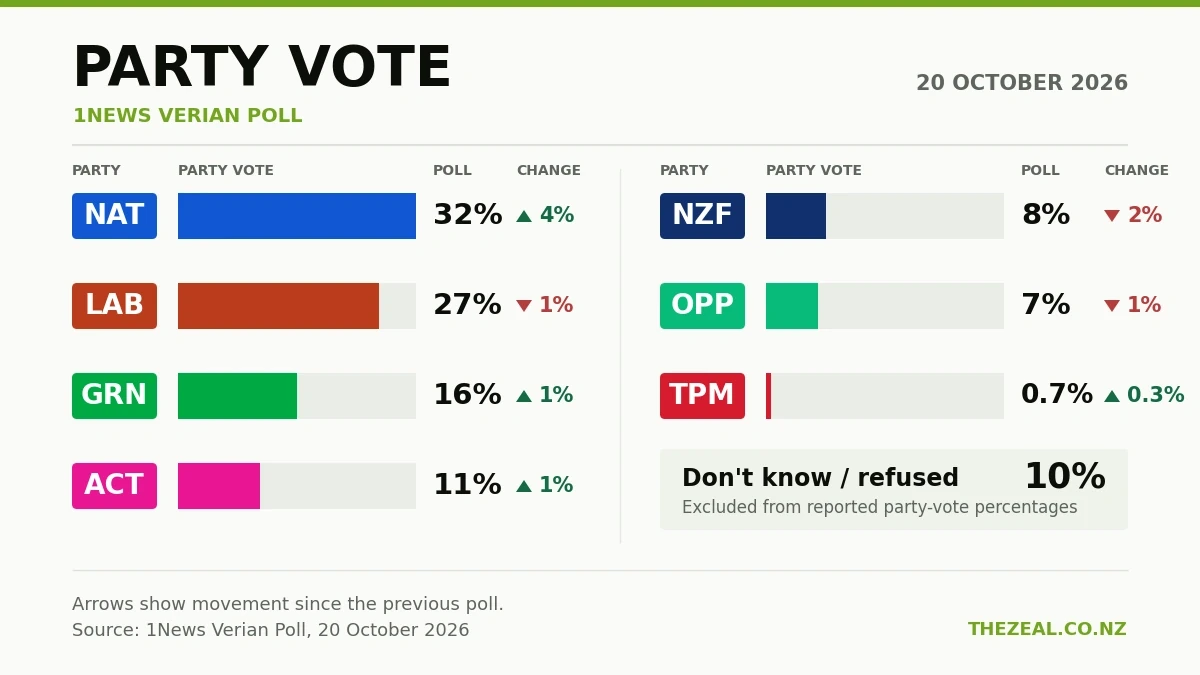
Prime Minister Christopher Luxon's National Party has surged four percentage points in the latest 1News Verian poll, opening a five-point lead over Labour. However, despite the recovery, the existing coalition of National, ACT and New Zealand First remains short of a parliamentary majority under both of the pollster's projected scenarios.
The 1News Verian poll, released Tuesday, October 20, places National on 32%, up from 28% a week earlier, while Labour has slipped one point to 27%, its lowest result since the 2023 general election.
ACT has climbed one point to 11%, while New Zealand First has fallen two points to 8%. The Greens rose one point to 16%, while Opportunity slipped from 8% to 7%, remaining above the 5% party-vote threshold required to enter Parliament without winning an electorate.
Te Pāti Māori remains below 1%, leaving its parliamentary representation dependent on winning electorate seats.
Under the poll's parliamentary projections, National would secure 38 seats, ACT 13 and New Zealand First nine, giving the existing coalition 60 MPs, insufficient to form a majority government.
Labour would secure 32 seats, the Greens 19 and Opportunity eight, giving those three parties a combined 59 MPs before Māori electorate representation is considered.
Verian has modelled two possible parliamentary outcomes, depending on the results in the Māori electorates. These scenarios account for potential overhang seats, which arise when a party wins more electorate seats than its share of the party vote would otherwise entitle it to.
Under the first scenario, Te Pāti Māori would retain four electorate seats and the Te Tai Tokerau Party one, creating four overhang seats and expanding Parliament to 124 MPs.
The existing coalition would hold 60 seats, three short of the 63 required for a majority. Labour, the Greens and Opportunity, together with the five Māori electorate MPs, would command 64 seats, enough to form a government if they could reach an agreement.
Under the alternative scenario, in which Te Pāti Māori secures just one electorate seat, Parliament would remain at 120 MPs. Both groupings, including Opportunity on the Labour side, would hold 60 seats, leaving neither with the 61 required for a majority.
Neither scenario accounts for a possible National Party overhang, which could also alter the parliamentary balance.
The results leave Opportunity leader Qiulae Wong in a potentially decisive position.
If Opportunity's eight projected MPs joined National, ACT and New Zealand First, the grouping would command 68 seats, comfortably exceeding the majority required under either scenario.
However, Luxon has repeatedly ruled out working with Opportunity, despite the party offering a possible route to another term in government.
Wong has indicated that Luxon would be her first call if the poll's projections were repeated on election night. If he refused to negotiate, she said she would approach Labour instead.
Meanwhile, Luxon remains ahead of Labour leader Chris Hipkins in the preferred prime minister rankings, holding steady at 20%, while Hipkins has fallen three points to 17%.
The poll also recorded improving economic sentiment, with 43% of respondents expecting the economy to improve over the next 12 months, compared with 21% anticipating a deterioration.
The proportion of respondents who were undecided or unwilling to disclose their party preference fell from 12% to 10%.
Verian surveyed 1,003 eligible voters between October 15 and 19, with a reported maximum sampling error of approximately ±3.1 percentage points. The results represent a snapshot of voter intentions rather than a prediction of the election outcome.
Advance voting begins Monday, October 26, ahead of the general election on Saturday, November 7.
Despite National's improved polling, the parliamentary arithmetic remains finely balanced. The outcome may ultimately depend less on which major party finishes ahead and more on the Māori electorate results and which party Opportunity chooses to support.

