





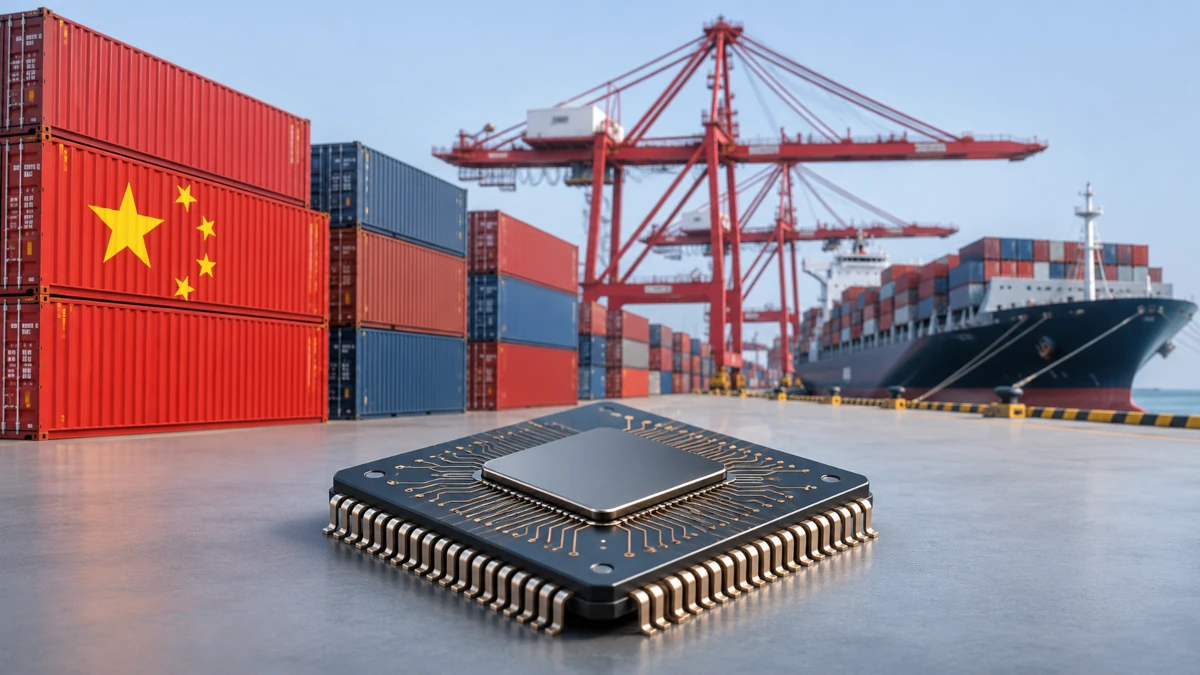
China's trade surplus has smashed through US$1 trillion in just ten months, fuelled partly by booming global demand for semiconductors and artificial intelligence infrastructure. But behind the impressive figures lies a surprising twist: China's chip exports have more than doubled in value, even though the number of chips shipped has barely increased.
According to customs figures released on November 10, China's goods trade surplus reached US$1.04 trillion between January and October, crossing the milestone a month earlier than in 2025. October exports surged 35.2% year-on-year, while imports jumped 41.6%, both measured in US dollars.
Chip Exports Boom, But There's a Catch
China exported approximately US$341.1 billion worth of integrated circuits during the first ten months of 2026, more than double the previous year's figure. Yet the number of chips exported rose just 3.2%, suggesting higher semiconductor prices and a shift towards more expensive products are driving much of the increase.
According to Trivium China, semiconductors accounted for more than one-fifth of China's export growth in October alone.
Memory chips appear particularly important. An analysis by the University of International Business and Economics found that memory products accounted for 71.6% of the value of Chinese chip-product exports during January–September, compared with 16.8% for processors and controllers.
Global investment in AI data centres has helped drive demand and prices higher. However, China's export boom extends beyond technology, with electric vehicles, solar equipment and lithium batteries also recording strong growth.
China's Race to Build Advanced Chips
China is making progress towards greater semiconductor independence. Its leading contract chipmaker, SMIC, has advanced beyond its earlier 7-nanometre-class manufacturing technology.
An independent analysis by TechInsights in August confirmed that Huawei's Kirin 9030 Pro processor uses SMIC's newer N+3 process. However, the technology remains less densely scaled than established 5nm processes from Taiwan's TSMC and South Korea's Samsung.
Restrictions on advanced extreme ultraviolet (EUV) lithography equipment continue to make producing competitive chips at scale more difficult and expensive.
Nevertheless, SMIC's business is booming. On November 12, the company reported a 123.4% jump in third-quarter profit, with revenue reaching a record US$3.19 billion. Notably, customers in China accounted for 90.8% of its revenue, illustrating the distinction between domestic chip manufacturing and China's export figures.
China's memory-chip manufacturers are also advancing. In September, CXMT announced mass production of its fifth-generation DRAM technology, including LPDDR5X memory chips.
Meanwhile, YMTC is planning a new factory capable of producing NAND flash memory with more than 300 stacked layers. According to Reuters, the company aims to source up to 70% of the facility's manufacturing equipment from domestic suppliers, although construction is not expected to begin until 2027.
The $225 Billion Semiconductor Deficit
Despite these advances, China still imports far more semiconductors than it exports.
During January–October, China imported approximately US$566.5 billion in integrated circuits against exports of US$341.1 billion, leaving a semiconductor trade deficit of around US$225 billion.
That deficit is already included in China's overall US$1.04 trillion goods trade surplus, with exports of other products more than making up the difference. Furthermore, not every chip exported from China was manufactured there. The country remains a major centre for assembling, packaging and testing semiconductors produced elsewhere.
Export Success, Domestic Struggles
China's export boom contrasts sharply with weak domestic consumer spending and a prolonged property downturn. Manufacturers remain reliant on overseas buyers, while the widening trade surplus risks intensifying tensions with the United States, European Union and other trading partners.
For now, the global AI investment boom is providing a powerful boost to China's export economy. However, doubling chip export revenue is one thing; competing with the world's most advanced chipmakers is another challenge entirely.

