


Cold War Spy Satellite Breaks Apart in Orbit
After 38 Years, USA 32’s Breakup Remains a Mystery

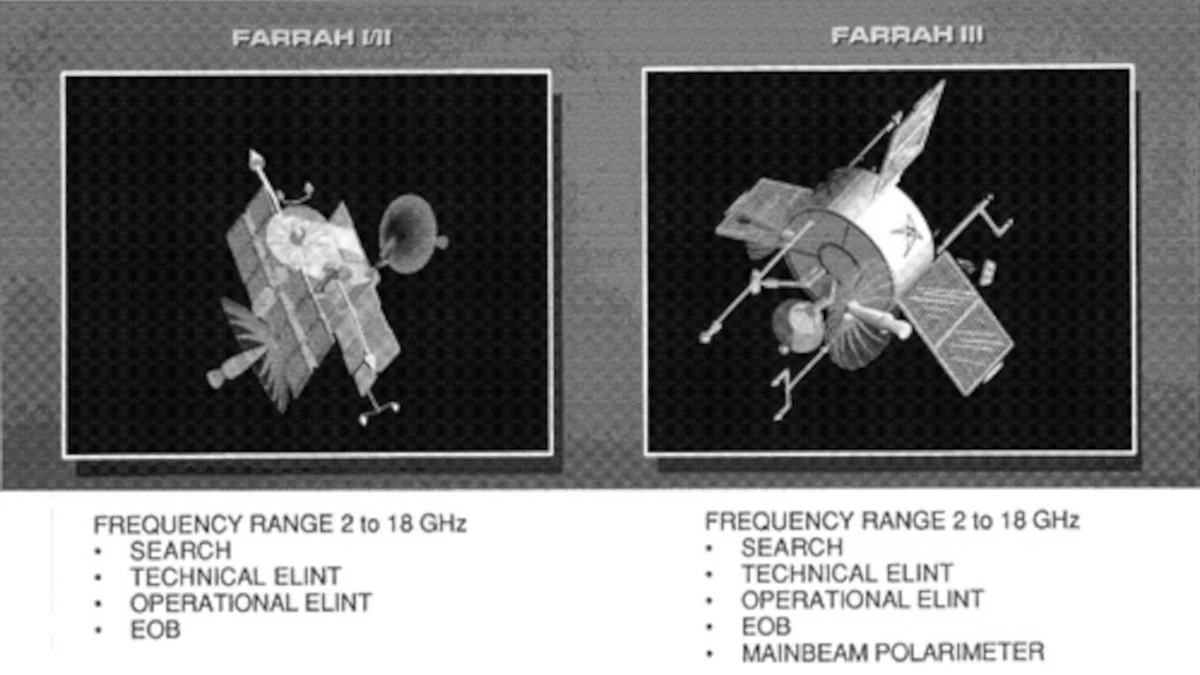
A Cold War-era American spy satellite believed to have weighed more than 1,360 kilograms has broken apart nearly 780 kilometres above Earth, scattering debris through low Earth orbit after spending almost four decades in space.
The spacecraft, USA 32, is widely identified as FARRAH III, a large, squat signals-intelligence satellite sometimes described as resembling a "tuna can". It belonged to a secret American satellite series named after actress and model Farrah Fawcett.
U.S. Space Forces-Space confirmed that USA 32, catalogue number 19460, fragmented on September 13, 2026 at approximately 21:13 UTC. Tracked debris is being included in routine collision-risk screening, and no immediate threat to other spacecraft was identified. As of October 2, the service has not announced what caused the breakup and says further analysis is continuing.
Private tracking companies were already seeing the aftermath within days. Swiss space-surveillance company s2a systems recorded USA 32 on September 16 and reported that a large number of fragments had dispersed across a wide section of its orbital track. Other reported optical observations showed a large surviving remnant accompanied by several smaller objects.
USA 32 had been circling Earth since September 5, 1988, when it was launched from Vandenberg Air Force Base in California aboard a converted Titan II intercontinental ballistic missile.
Before it broke apart, public orbital data placed the satellite roughly 773 to 780 kilometres above Earth, travelling around the planet once every 100.4 minutes. Its orbit was almost circular, meaning its altitude changed by only a few kilometres between its lowest and highest points rather than following a strongly elongated path.
Its inclination of about 85 degrees made it near-polar. On each circuit, its ground track ran almost north-to-south while Earth rotated underneath it, causing successive passes to cross different longitudes and giving the satellite access to large areas of the planet.
That type of orbit suited FARRAH III's original purpose.
The satellite was built for the National Reconnaissance Office, or NRO, the U.S. government agency responsible for developing, acquiring, launching and operating many of America's intelligence satellites.
Declassified Mission 7300 records describe the FARRAH system as carrying out general and directed searches, technical intelligence and operational electronic-intelligence missions, including building an electronic order of battle by locating and characterising foreign military emitters.
During the Cold War, Soviet radar and other military systems were among the programme's highest-priority targets. Its near-polar orbit allowed FARRAH to repeatedly pass across the Soviet Union and other areas of interest while maintaining access to targets elsewhere around the world.
The satellite did much more than simply record radio noise.
FARRAH's receivers were designed to identify and measure radar and communications emissions, including relatively faint signals spilling from the sides of radar beams. Those "sidelobes" could reveal the presence, location and characteristics of military radar systems even when the main beam was pointing somewhere else.
FARRAH III carried three large high-gain parabolic antennas covering different frequency ranges between about 0.8 and 18 GHz, along with smaller omnidirectional antennas.
The dishes concentrated weak signals onto the satellite's receivers, increasing its sensitivity to distant emitters. The highest-frequency receiver even used cooled front-end electronics to improve its performance.
FARRAH III also carried a Tactical Onboard Processor. Some processing could be performed aboard the satellite before data was sent directly to fixed ground stations, mobile military receivers and even ships at sea. Signals could either be stored for later transmission or relayed while they were being collected.
The spacecraft was also spinning remarkably fast: about 50 revolutions per minute, or one complete rotation every 1.2 seconds.
That was deliberate.
FARRAH III was spin-stabilised, an established method of attitude control in which the angular momentum of the rotating spacecraft helps keep its orientation stable.
For FARRAH, the rotation also served the intelligence mission. As the satellite spun, its directional antenna beams swept across Earth's surface. Combined with the spacecraft's movement along its orbit, those repeated sweeps allowed it to search large geographical areas for electronic emissions.
Fifty revolutions per minute would be unusual for many modern satellites, which often rely on reaction wheels and computer-controlled three-axis stabilisation, but spin-stabilised spacecraft were well-established technology. FARRAH's rotation was part of how the satellite worked.
Its longevity is equally striking.
FARRAH III appears to have been designed around a nominal operational lifetime of only three years, yet declassified records show that it and the later FARRAH V were still operating in late 2004.
Observers continued detecting their characteristic rotation many years later, although there is no publicly established date for when FARRAH III finally stopped performing its intelligence mission.
The three-year design life did not mean the satellite was expected to fall from the sky after three years.
The FARRAH family was solar powered. Declassified documentation for the earlier FARRAH II describes deployable solar arrays, a charging system and onboard batteries, while released material concerning the larger FARRAH III design also indicates the use of solar arrays. Detailed specifications for FARRAH III's electrical system have not been publicly established.
Remaining in orbit does not require an engine to run continuously either.
An orbiting satellite is effectively falling around Earth, travelling sideways fast enough that the planet's curved surface continually falls away beneath it. At around 780 kilometres there is still an extremely thin atmosphere, but drag is weak enough for a spacecraft to remain in orbit for decades after its electronics, batteries or propulsion systems stop functioning.
After 38 years, however, something caused USA 32 to come apart.
No confirmed explanation has emerged.
An ageing spacecraft can retain stored energy in batteries and pressurised systems capable of producing a violent failure. Alternatively, USA 32 could have been struck by orbital debris or a natural micrometeoroid travelling at high relative speed. At orbital velocities, even a comparatively small object can cause severe damage.
German space-safety company OKAPI modelled both a high-speed collision and an internal battery explosion because there is not enough public evidence to favour either explanation.
Its simulations found that a breakup could leave several major structures intact, including some of the satellite's dishes, solar panels and part of the main body. Optical reports after the event showed a large remnant accompanied by several nearby objects, although OKAPI cautions that there is not enough evidence to identify those pieces.
There is also no public evidence that USA 32 was deliberately destroyed.
U.S. Space Forces-Space has described what occurred as a fragmentation and has made no attribution to an anti-satellite weapon, hostile action or any other deliberate attack.
Claims that the spacecraft "exploded" therefore go further than the official finding. An internal explosion remains one possible explanation, but it has not been established.
How much debris was created is also unknown. U.S. authorities have not published a definitive fragment count.
In 40 simulations, OKAPI produced between about five and 250 pieces larger than 10 centimetres, depending on the type and energy of the breakup.
Using the NASA Standard Breakup Model, its broader debris scenario contained roughly 3,500 fragments larger than one centimetre. Those are modelling estimates, not 3,500 observed pieces of USA 32.
At roughly 780 kilometres, some of the debris could remain in orbit for decades. Larger pieces can generally be tracked and included in collision warnings, while centimetre-scale fragments are considerably harder to follow despite being capable of seriously damaging another spacecraft.
USA 32 has now entered an unusual final chapter.
A satellite launched in 1988 to locate and analyse electronic signals from military systems below Earth is now being watched from the ground for an entirely different reason.
What caused USA 32 to suddenly fragment after 38 years in orbit still remains unknown.