




Disputed El Gaia Attack Deepens Hormuz Crisis
Iran Says Tanker Hit a Mine. Washington Says Iran Attacked It.

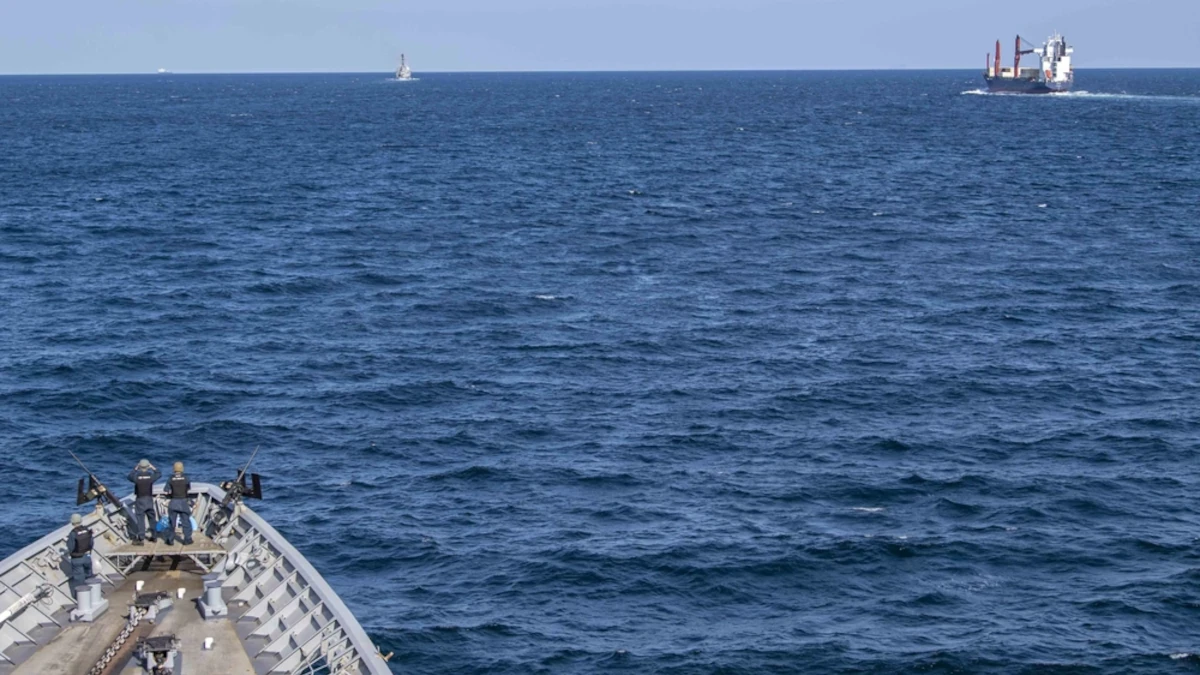
A damaged oil tanker in the Strait of Hormuz has become the centre of sharply conflicting claims from Iran and the United States, as commercial traffic through one of the world's most important energy routes falls to a fraction of normal levels.
What is known is that the Panama-flagged El Gaia, IMO number 9325336, suffered a serious security incident over the weekend that led to a fire, the evacuation of crew members and an oil spill.
What caused it is much less certain.
Iran's Islamic Revolutionary Guard Corps says the tanker struck a naval mine after entering a restricted area of the Strait of Hormuz. US Central Command rejects that account, saying Iran itself attacked the vessel with a drone after previously hitting it with a missile.
The United Kingdom Maritime Trade Operations centre reported that at 2300 UTC on Saturday, September 12, early Sunday morning local time, an unidentified vessel transiting the Strait of Hormuz had been struck by an unknown projectile. A subsequent update said a fire had broken out and local authorities were assisting with the evacuation of crew members.
A later maritime navigation warning identified El Gaia as a vessel involved in a security incident and reported it on fire, drifting and spilling oil roughly 3.6 nautical miles northwest of Jazirat Musandam, close to the narrow entrance to the Persian Gulf.
The UN's International Maritime Organization also lists El Gaia among confirmed Middle East maritime incidents, recording the tanker as damaged in the Strait of Hormuz with pollution of unknown extent. The IMO has not attributed the incident to a mine, missile or drone.
India's Ministry of External Affairs said 14 Indian seafarers were aboard the vessel, with 13 rescued and one Indian national still missing. India's embassy in Oman has been coordinating with Omani authorities on the search.
The IMO separately lists two seafarers as missing overall, although it does not identify their nationalities.
The IRGC Navy said on Monday that El Gaia had passed through what Iran considers a prohibited zone in the southern part of the strait before striking a naval mine. The force said efforts to control the resulting fire had failed and used the incident to repeat its position that the Strait of Hormuz remains closed and under Iranian control.
US Central Command called the Iranian account false and said El Gaia had already been struck by an Iranian missile last month and rendered inoperable. According to the US military, Iran then attacked the tanker again with a drone over the weekend while it was sitting in waters off Oman. CENTCOM says the vessel is now being towed by a regional partner.
Reuters said it could not immediately contact the ship's owners in Dubai to verify the competing accounts. Independent maritime authorities confirm that El Gaia was damaged in a security incident that caused fire and pollution, while UKMTO reported an unidentified vessel in the strait being struck by an unknown projectile at about the same time.
There has also been no authoritative public confirmation of what cargo, if any, El Gaia was carrying when it was hit. Classification society ClassNK describes the 2005-built vessel as an oil carrier with a deadweight capacity of 47,999 tonnes, a gross tonnage of 28,799 tonnes and an overall length of about 180 metres. Those specifications place El Gaia well below the size normally associated with a supertanker.
The dispute over El Gaia comes as commercial shipping through Hormuz falls to extraordinary lows. Preliminary Kpler tracking data cited by Reuters showed only four commodity vessels crossed the strait on Monday, down from 10 on Sunday. Two dry-bulk vessels left the Persian Gulf, while two oil tankers entered. Both tankers were travelling in ballast, meaning they were not carrying oil cargo.
The figures do not capture ships travelling with their Automatic Identification System transmitters switched off, something vessels sometimes do in dangerous waters to make themselves harder to locate. Even allowing for so-called dark traffic, the collapse in visible shipping is severe.
Iran's latest declaration should also be viewed in context. Tehran has not suddenly closed an otherwise normally functioning waterway because of the El Gaia incident. Commercial traffic through Hormuz has already been heavily disrupted for months.
The IRGC statement therefore appears to be a reassertion of Iran's claimed control over passage through Hormuz. For shipping companies, the immediate question is less about legal declarations than whether owners, crews and insurers are willing to send vessels through a waterway where commercial ships are being attacked.
Those risks are becoming increasingly expensive. Emirates National Oil Company director Paul Bradshaw said last week that war-risk and cargo insurance charges had pushed the additional cost of some Hormuz voyages into the US$10 million to US$20 million range.
Alternative routes are also under pressure. Saudi Arabia's East-West oil pipeline, which allows crude to reach the Red Sea without passing through Hormuz, remains offline following an attack Saudi Arabia blamed on Iran-backed fighters in Iraq. Reuters reported that around 4 million barrels per day had been moving through the pipeline.
The disruption is feeding directly into energy markets. In Tuesday trading, Brent crude climbed above US$108 a barrel, while US West Texas Intermediate rose above US$103, with both benchmarks up more than 2%.
The Strait of Hormuz has historically carried oil flows equivalent to roughly 20% of global petroleum-liquids consumption. It is also critical for liquefied natural gas, with more than 20% of global LNG trade normally passing through the waterway.
El Gaia has therefore become more than an isolated tanker incident. Iran says the vessel struck a mine after entering a restricted area. Washington says Iran attacked it directly. Independent authorities have not yet established which account is correct.
What is clear is the scale of the wider disruption. Kpler recorded just four commodity-vessel transits through Hormuz on Monday, while before the war the strait typically handled around 125 large commercial vessels of all types each day. Some ships now travel with their tracking systems switched off, making the comparison imperfect, but the collapse in visible traffic is unmistakable.

