





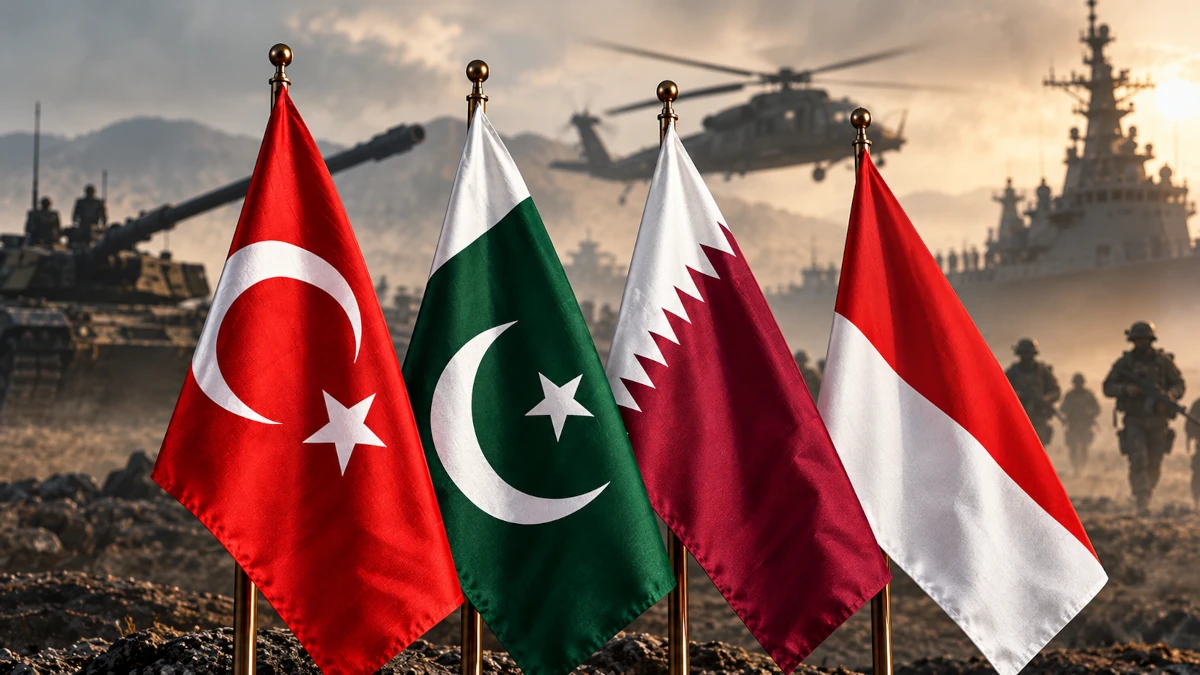
Turkey, Pakistan, Qatar and Indonesia have signed a new defence cooperation agreement aimed at strengthening military production and reducing reliance on foreign weapons suppliers, amid growing uncertainty over security arrangements in the Middle East and Asia.
The agreement, known as the Badr Memorandum of Understanding, was signed in Doha on October 21 by representatives of the four countries' defence ministries and industrial authorities. The name Badr means "full moon" in Arabic, which Qatari authorities say symbolises the complementary strengths of the four nations.
According to Turkey's Defence Ministry, the arrangement will promote joint military production, technical training, research and development, while allowing participating countries to combine their industrial capabilities.
Each nation brings different strengths. Turkey has an established defence manufacturing industry, Pakistan and Indonesia offer production capacity and large domestic markets, while Qatar provides substantial investment potential.
The agreement builds on existing partnerships. Turkey already cooperates with Pakistan on naval manufacturing and with Indonesia on armoured vehicles, while maintaining a military base in Qatar.
The move comes amid heightened regional tensions, particularly the ongoing conflict involving Iran, which has raised questions about the reliability of traditional security arrangements and encouraged countries to diversify their defence relationships.
Turkey, which has NATO's second-largest military, has increasingly expanded defence cooperation beyond its Western allies. Qatar also hosts Al Udeid Air Base, a major American military installation, highlighting how the new partnership brings together countries with different strategic relationships.
No official US government response to the agreement had been publicly confirmed as of October 22. However, closer industrial cooperation could eventually reduce the participating nations' dependence on Western military equipment and technology.
Unlike a formal mutual-defence treaty, the Badr agreement does not establish an obligation for the four countries to defend one another if attacked. Instead, it provides a framework for developing military equipment and sharing technical expertise.
Qatari authorities have also confirmed that other friendly nations may join the initiative, subject to conditions agreed upon by the four founding members.
Whether Badr develops into a wider defence partnership will depend on the countries turning their agreement into practical projects. For now, it signals a growing determination to strengthen domestic military industries while maintaining existing international security relationships.

