





If you have not been following events in France, what is happening there can look surprisingly sudden.
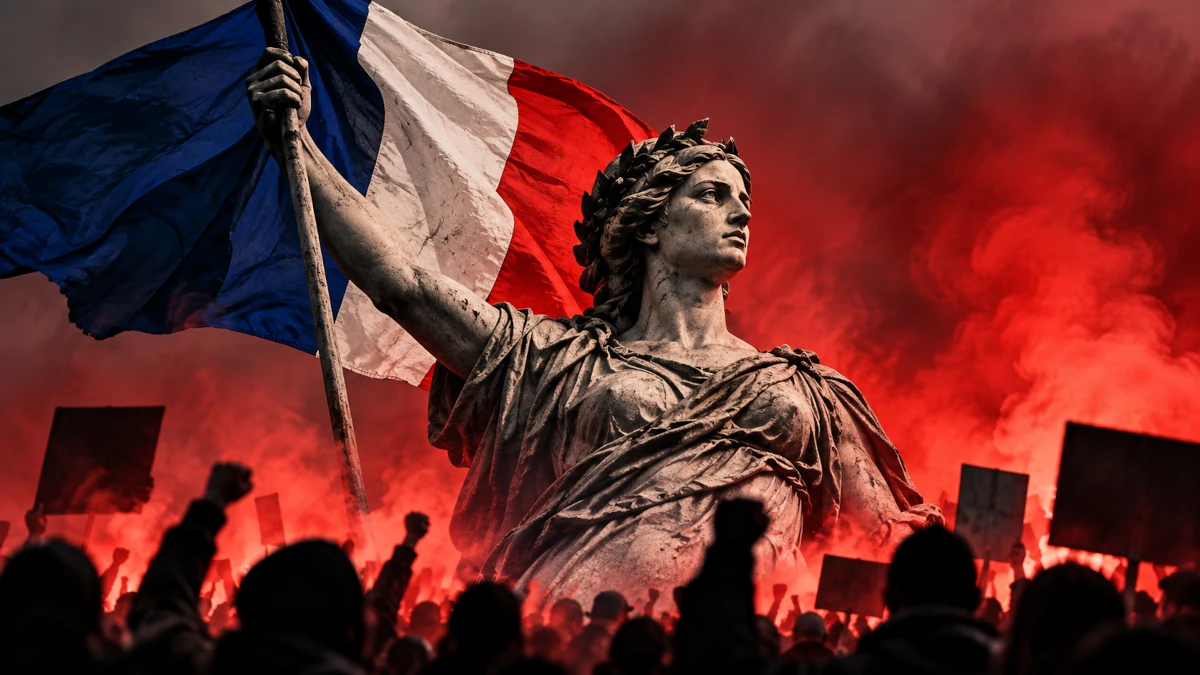
Since protests began in the Paris region in September, demonstrations have spread across the country. More than 1,200 high schools were affected during one week alone, thousands of people have been arrested and confrontations between young protesters and riot police have produced scenes of fires, tear gas and damaged schools.
By Saturday, October 3, French authorities said around 5,000 people, mostly teenagers, had been arrested during the week's unrest. More than 600 police officers had also been injured. Paris police chief Patrice Faure described the movement as being "out of control".
But this did not begin as a riot.
The first protests grew out of complaints that sound considerably less dramatic than the images now coming out of France.
Students complained about missing teachers, overcrowded classrooms, deteriorating buildings, long school days and unequal educational opportunities between wealthier areas and poorer suburbs.
At one school north of Paris, classes in subjects including maths, English and humanities had been cancelled since the start of the academic year because teachers were unavailable. One 17-year-old told Reuters she had sat an important French exam the previous year without having a French teacher.
Students and teachers elsewhere have described classrooms that become unbearably hot in summer or cold in winter, leaking or damaged buildings and shortages of nurses, social workers and other staff.
Some students simply stood outside school gates or blocked entrances. Elsewhere, however, the protests descended into violence.
Bins, vehicles and other property have been set on fire. Schools have been damaged or set ablaze. Fireworks and other projectiles have been fired towards police, and riot officers have responded with tear gas and mass arrests.
At that point, the story stopped being simply about education.
The French government accepts that students have legitimate grievances, but argues that parts of the movement have increasingly been exploited by organised political activists and violent groups.
At a government crisis meeting on October 1, intelligence agencies reportedly assessed that La France Insoumise, commonly known in English as France Unbowed, or LFI, and far-left groups associated with the movement were helping organise the unrest. Interior Minister Laurent Nuñez has separately said that agitators were moving between schools in some areas to incite violence.
LFI strongly denies that it organised the protests or is responsible for the violence.
The hard-left party, led by veteran politician Jean-Luc Mélenchon, openly supports the students' demands and its politicians have appeared at demonstrations. Mélenchon has also condemned the violence and says the movement should remain non-violent.
Reporting from the demonstrations suggests the reality is more complicated than either political side's version.
Many of those taking part are students protesting conditions in their schools. Authorities and reporters have also described outsiders and other participants apparently seeking confrontation or attaching themselves to the wider movement as violence has increased.
That distinction matters. France is dealing with both a genuine student protest movement and increasingly serious public disorder at the same time.
The wider significance becomes clearer when France's position within Europe is taken into account.
France is the European Union's second-largest economy by GDP and is one of the 21 EU countries that use the euro. Because those countries share a currency and common monetary policy, France's economic and fiscal problems are closely watched well beyond its borders.
Behind the current unrest sits another problem that is becoming increasingly difficult for the French government to ignore: money.
France's public debt has climbed to around 119 percent of the country's annual economic output.
The government is also spending considerably more than it collects, with its 2027 budget based on an estimated deficit of around 5.4 percent of GDP this year.
For comparison, European Union fiscal rules use 3 percent of GDP as the reference value for annual government deficits.
Investors have also been demanding higher returns to lend money to the French government.
France's benchmark 10-year borrowing cost recently climbed to around 4.96 percent, its highest level since July 2002. That matters because as older government debt issued at very low interest rates matures and is replaced with more expensive borrowing, a growing share of government revenue has to be devoted to servicing the debt.
The French government plans to issue a record €340 billion of debt next year to cover its deficit and refinance maturing bonds.
At the same time, its proposed 2027 budget contains a fiscal effort worth around €54 billion, including approximately €43 billion in measures that are new next year.
The proposals include freezing public-sector wages, limiting pension increases for many retirees, restraining healthcare costs, reforming sick-pay entitlements and reducing some tax breaks.
The picture is slightly more complicated when it comes to schools themselves. The government has proposed €65.5 billion for education in 2027, an increase of around 1.7 percent, but that increase is below inflation and comes while students and teachers say existing staffing and infrastructure shortages remain unresolved.
That tension is now visible on the streets.
Students are demanding more teachers, better-maintained schools and greater public resources.
The government is simultaneously trying to reduce its deficit through spending restraint and additional revenue.
Complicating all of this is an approaching presidential election.
France will elect its next president in two rounds scheduled for April 18 and May 2, 2027. Current President Emmanuel Macron cannot seek a third consecutive term under the French constitution.
The political differences between the main figures in this story are substantial. Macron built his presidency around the political centre. Marine Le Pen is the leading figure of the far-right National Rally, while Jean-Luc Mélenchon and LFI sit on the hard left.
Le Pen is currently ahead in national polling reported by Reuters, while Mélenchon is also polling strongly enough to be a serious contender for the second-round runoff. Centrist candidates hoping to succeed Macron are attempting to hold ground between the two.
The unrest has therefore landed in the middle of an increasingly polarised presidential race.
For Le Pen and other politicians campaigning heavily on law and order, images of burning buildings and clashes with police have provided a new issue to focus on. Le Pen has already called for tougher police powers to deal with rioters.
For Mélenchon and the hard left, the protests reinforce their argument that public services have been neglected and that disadvantaged communities are bearing too much of the burden.
Neither interpretation tells the whole story, but both are now part of the political battle surrounding the unrest.
France may find out very quickly whether the current unrest has reached its peak or is developing into something larger.
Student organisations have called for renewed national demonstrations on Tuesday, October 6, while teachers' unions have also called for strike action.
If the school movement begins merging with wider opposition to the government's fiscal plans, France could find itself facing something much broader than a student revolt.
The unrest has exposed a larger collision between demands for stronger public services and a government already under pressure to restrain its deficit and rising borrowing costs.
Even if the demonstrations eventually subside, those economic and political pressures will remain, and France will carry them directly into the 2027 presidential election.

