



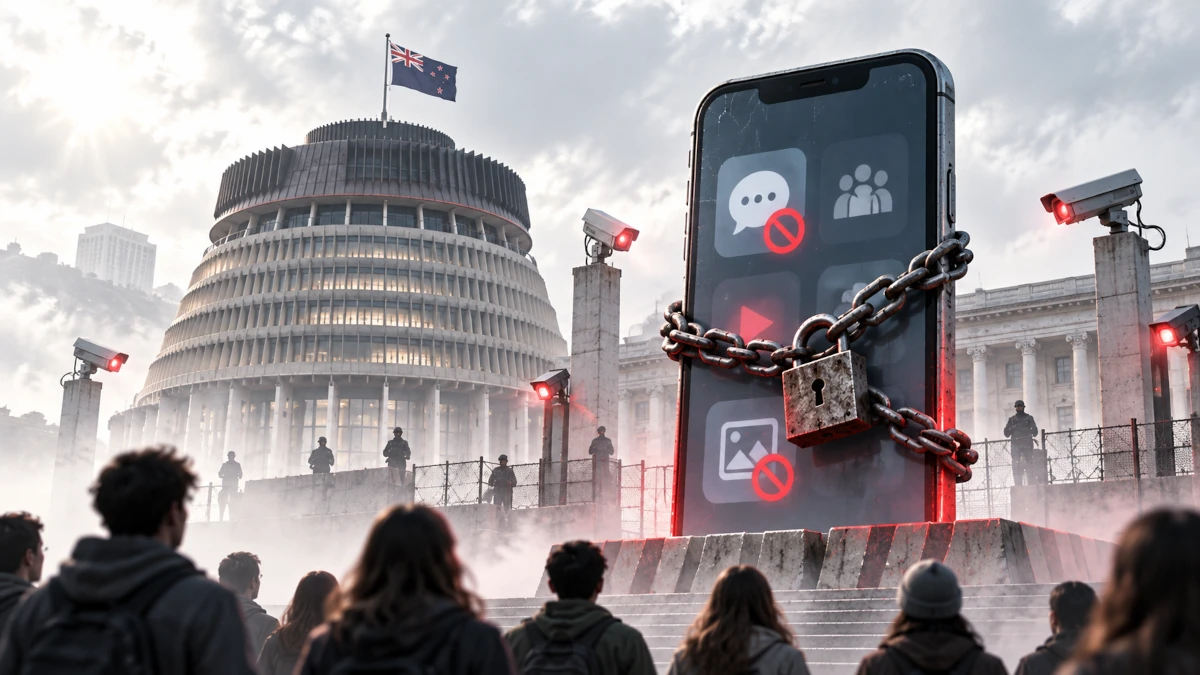
New Zealand's Labour Party has announced plans for an independent online regulator with powers to fine technology companies, alongside an under-16 social media ban and new legislation covering gaming platforms and artificial intelligence.
The policy, announced on Monday, October 19, would introduce a Digital Duty of Care requiring online services to address what Labour describes as "online harm", raising concerns about government oversight of lawful speech and parental rights.
Labour leader Chris Hipkins said technology companies had too much influence over people's online experiences, citing scams, deepfakes and harmful content.
"Parents shouldn't have to take on big tech on their own," Hipkins said.
Under-16 Social Media Ban
Labour has pledged to advance the Government's existing Online Safety Bill through its first reading and into select committee within its first 100 days in office, with additional privacy safeguards for age-verification systems.
Introduced in August, the bill would require designated platforms to take "reasonable steps" to prevent children under 16 from holding accounts, regardless of parental consent. It would also cover certain AI companion services.
The restriction applies to accounts rather than access to social media itself, meaning children could still view publicly available content without signing in.
Under the proposed legislation, the High Court could order companies found in breach to pay penalties, with the maximum reaching NZ$40 million or 10% of relevant global turnover, whichever is greater. However, enforcing such orders against overseas operators could prove difficult, if not impossible.
If enacted, the bill would also allow the High Court to order New Zealand internet service providers (ISPs) to block access to non-compliant platforms, potentially through domain-name or IP-address blocking.
Such restrictions could affect all New Zealanders, not just under-16s, potentially driving users towards VPNs or alternative internet providers such as satellite-based Starlink. However, Starlink itself could also be subject to New Zealand court orders.
New Powers Over Online Platforms
Labour's separate Digital Duty of Care proposal would extend regulatory requirements to social media, gaming platforms, apps and AI chatbot services.
Companies would be required to assess online risks, address "harmful content" and addictive design features, and introduce stronger protections for users under 18. Whether overseas companies would comply with these requirements, and how New Zealand authorities could compel them to do so, remains unclear.
The policy also proposes measures against deepfake abuse and non-consensual sexual imagery, including powers to remove applications or block access to websites used to generate such material. However, Labour has not explained how these powers would be enforced against services hosted overseas.
An "independent online regulator" would investigate alleged breaches and enforce the proposed standards.
Labour would also require social media companies to let users aged 16 and over choose between algorithmically recommended content and posts from accounts they follow. Whether a New Zealand regulator could compel overseas platforms to provide such options remains an open question.
The proposed Digital Duty of Care follows Australia's approach. Similar controversial legislation was introduced to the Australian Parliament on October 15 but has yet to become law.
Free Speech and Parental Rights
The Free Speech Union has criticised Labour's proposals, warning that loosely defined obligations to prevent "online harm" could give regulators influence over what adult New Zealanders can legally say and view online.
Executive director Jillaine Heather described the proposal as a plan for the government to determine which lawful speech was too harmful for adults, questioning the absence of a clear legal definition.
New Zealand First leader Winston Peters also criticised the under-16 ban, arguing that parents should retain responsibility for their children's social media use. He questioned whether effective enforcement would require widespread digital identification or restrictions on VPN services.
Labour has previously legislated to restrict access to online material. Controversially, under Jacinda Ardern's Labour Government, a 2021 amendment to the Films, Videos, and Publications Classification Act introduced takedown notices for online material classified, assessed as likely to be, or reasonably believed to be objectionable.
Those powers operate within New Zealand's existing classification framework. Labour's proposed Digital Duty of Care would cover a wider range of online activity, although the party has yet to publish the legislation, leaving the definition of "online harm", the regulator's enforcement powers and safeguards for lawful expression unspecified.
Labour's priorities warrant scrutiny. While the party proposes greater government oversight of social media platforms where New Zealanders exchange information, debate politics and challenge those in power, its announced policy does not propose comparable age restrictions for conventional pornography websites.
Rather than leaving decisions about children's social media use to parents, Labour has pledged to introduce legislation that would prevent under-16s from holding accounts on designated platforms, regardless of parental consent. Its proposed wider regulatory powers also raise concerns about potential restrictions on lawful speech, including criticism of the government.
Neither Labour's announced policy nor National's existing bill specifically addresses the Tor network or the fool's errand of attempting to regulate anonymous online services. Instead, both parties are focusing primarily on mainstream platforms used by millions of New Zealanders, many of which provide forums for political debate and criticism. While the stated objective is online safety, how far government oversight should extend into lawful public discussion and what safeguards would prevent censorship are questions that deserve answers.