




NASA’s Roman Telescope Could Last 22 Years
Fuel Savings More Than Double Its 10-Year Design Goal

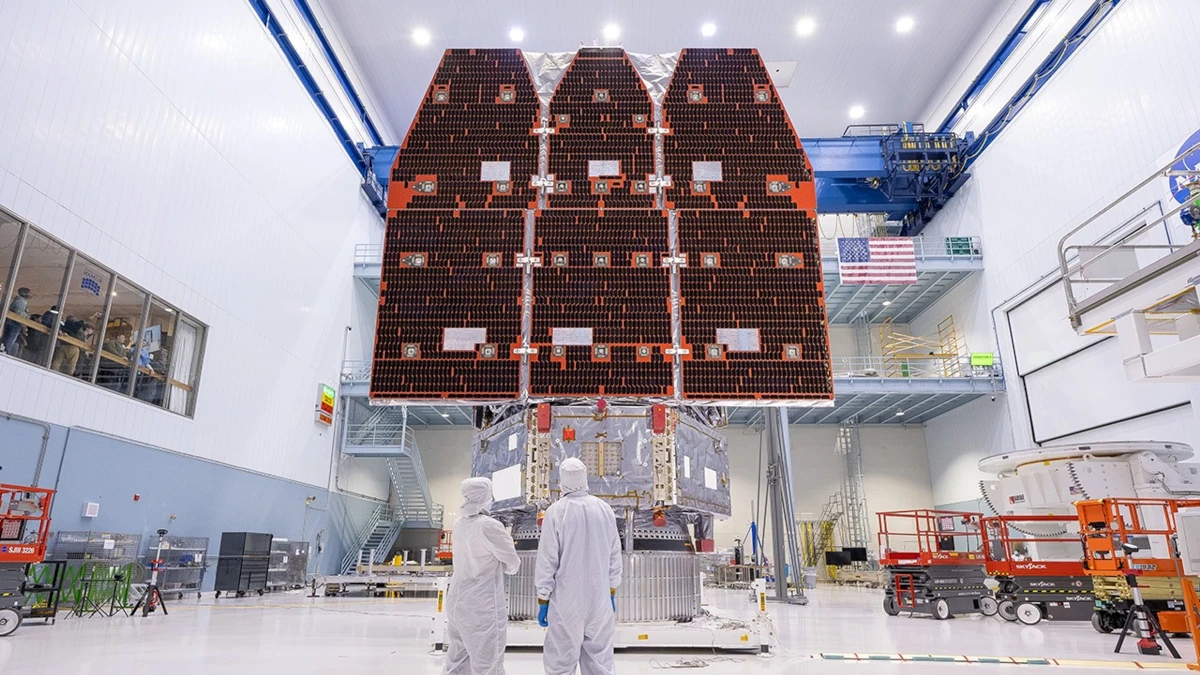
NASA’s newest major space telescope may be able to operate for at least 22 years, more than twice its 10-year design goal, after launching lighter than expected and using far less propellant than planned on its journey into deep space.
The Nancy Grace Roman Space Telescope launched from NASA’s Kennedy Space Center in Florida aboard a SpaceX Falcon Heavy on August 30. It is named after Nancy Grace Roman, NASA’s first chief astronomer, who became known as the “mother of Hubble” for helping turn the space telescope from an idea into reality. Roman is designed to study dark energy, dark matter, distant galaxies and planets beyond our solar system.
NASA said on September 14 that Roman now has enough fuel for at least 22 years of potential science operations. The telescope was designed for a five-year primary mission and another five years of possible extended operations. Roman launched lighter than engineers had conservatively planned for, allowing its fuel tanks to be filled beyond what was needed for the original 10-year target.
Its first major course correction was also more than 99% accurate and used only about 18 kilograms of propellant, compared with the 200 kilograms budgeted for the manoeuvre.
Roman is now travelling towards the second Sun-Earth Lagrange point, or L2, about 1.5 million kilometres from Earth in the direction opposite the Sun. It is expected to enter an orbit around L2 in early December, joining the James Webb Space Telescope in the same broad region of space. The gravity of the Sun and Earth, together with the spacecraft’s motion around the Sun, allows Roman to maintain a relatively steady orbit while using little fuel.
Roman’s 2.4-metre primary mirror is the same diameter as Hubble’s, but its Wide Field Instrument can capture an area of sky at least 100 times larger in a single observation while producing similarly sharp images. NASA says that combination will allow Roman to survey the sky up to 1,000 times faster than Hubble.
The mirror itself has an unusual past. It was transferred to NASA in 2012 by the US National Reconnaissance Office, the agency responsible for America’s reconnaissance satellites. NASA engineers modified its shape and surface for astronomy, then coated it with an extremely thin layer of silver chosen for its ability to reflect near-infrared light.
Roman is still undergoing commissioning on its journey to L2, with its systems and instruments being calibrated and tested. NASA expects to release its first science images in early 2027.

