




National’s 5% Mortgage Gamble
Lowering the Deposit, Not the Price

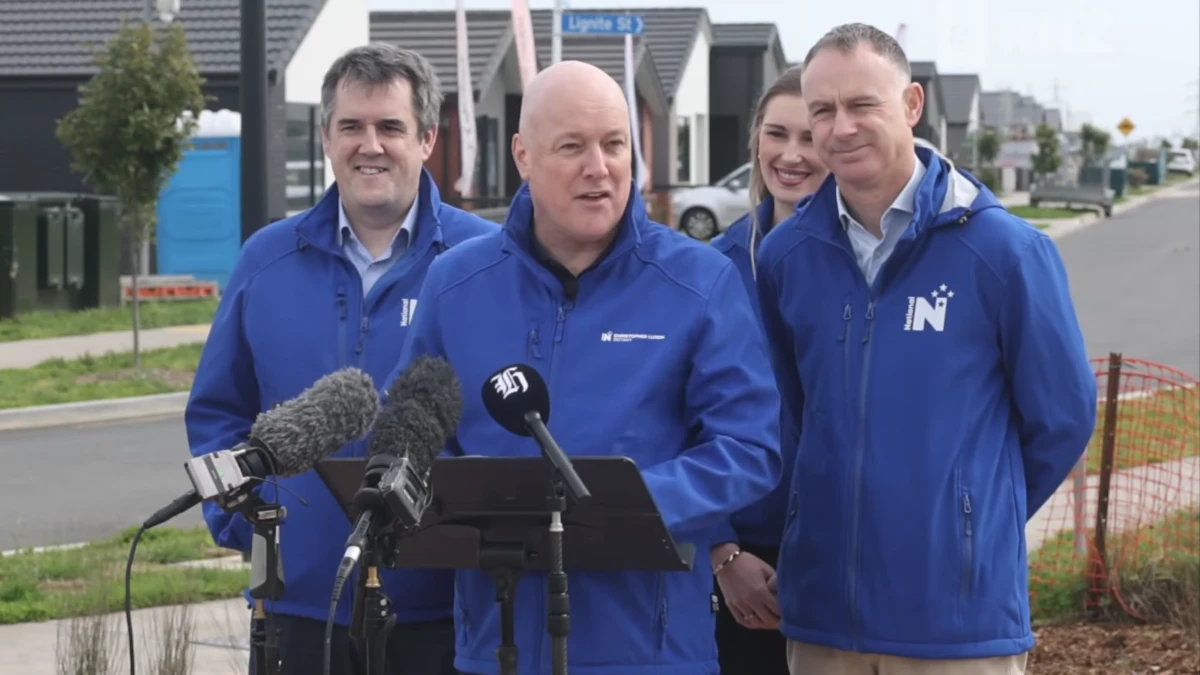
National has discovered a wonderfully New Zealand solution to expensive houses: don’t make the house cheaper, make the deposit smaller and the mortgage fatter. Oy vey.
Housing Minister Chris Bishop announced on Sunday that, if National is re-elected, it will dramatically widen Kāinga Ora’s First Home Loan scheme. The income ceiling would rise to $300,000, allowing qualifying first-home buyers to purchase with deposits as small as 5%. First things first: this is an election promise, not current policy.
Today, a single buyer without dependants must earn $95,000 or less to qualify. A single buyer with dependants can earn up to $150,000, while multiple buyers are capped at $150,000 combined. National wants one great big $300,000 ceiling instead.
The political shtick is understandable. Deposits are enormous, rents are expensive, and saving $150,000 while paying somebody else’s mortgage is miserable. But National’s announcement does something very specific: it makes the deposit cheaper. It does not make the house cheaper. Those are not the same thing.
The 5% Magic Trick
New Zealand’s median sale price was $760,000 in July. A normal 20% deposit is $152,000. A 5% deposit is just $38,000. Much nicer.
Unfortunately, the missing $114,000 has not gone the way of Elijah, swept heavenward in a chariot of fire. It remains stubbornly earthbound, sitting inside the mortgage. Instead of borrowing $608,000, the buyer borrows roughly $722,000.
Kāinga Ora also charges a 1.2% Lenders Mortgage Insurance premium, which can be added to the loan. On $722,000, that is another $8,664. So yes, you enter the house with $38,000. Mazel tov. The bank walks in behind you carrying an invoice approaching $731,000.
For somebody with a strong income but little savings, that may be genuinely useful. It could bring home ownership forward by years. But National is not making the property more affordable. It is replacing more of the buyer’s capital with the bank’s capital — plus interest. Access to credit and housing affordability are cousins, not twins.
Singles Still Have One Salary
National’s announcement becomes particularly interesting for people buying alone. The eligibility ceiling for a single applicant would leap from $95,000 to $300,000. That sounds generous, but qualifying for the scheme and qualifying for the mortgage are two very different things.
Take a single buyer earning $100,000 and purchasing our $760,000 median house with a $38,000 deposit. The mortgage is about $722,000, or 7.22 times gross annual income, before student loans, car finance, credit cards or mortgage insurance.
The Reserve Bank normally considers owner-occupier borrowing above six times income to be high-DTI lending. Here is the interesting bit: Kāinga Ora First Home Loans are exempt from the Reserve Bank’s DTI and LVR restrictions. The bank still has to assess affordability, but the government-backed loan itself gets a hall pass from those macroprudential limits.
At an illustrative 5.5% over 30 years, $722,000 costs around $4,100 a month, or just over $49,000 a year, before council rates, insurance and maintenance. That is almost half a $100,000 buyer’s gross salary before Inland Revenue has even had its nosh.
The bank may simply say no, and therein lies the problem with presenting a $300,000 eligibility ceiling as though it solves single-person home ownership. National can raise the limit to $300,000 or three million shekels, but it cannot make one ordinary salary service a giant mortgage. Couples have two incomes. Singles have one. A smaller deposit does nothing to change that arithmetic.
About That Record 29%
Bishop also says first-home buyers are “dominating” the market, pointing to their 29% share of purchases in July, the highest in more than 20 years. The number is real, and their actual transaction numbers have also increased, so this is not statistical fakery.
But there is a rather important sentence missing from the campaign brochure: first-home buyers are taking a record share of a shrinking housing market.
Cotality says total property sales fell around 6% year-on-year in July. REINZ’s separate figures showed just 6,090 sales, down 10% from July 2025. Inventory was up 9.3%, movers are cautious, investors have been weak, and buyers have more stock to choose from.
First-home buyers are eating a bigger slice. The pizza itself has got smaller.
Mortgage figures tell much the same story. First-home buyers accounted for 20.1% of new mortgage commitments, up from 19.4% a year earlier, but the actual amount lent to them fell about 10%. Their share increased because total mortgage lending fell even harder, by 13.1%.
So yes, first-home buyers are doing relatively well. But let’s not throw a bar mitzvah for the denominator.
A 5% Deposit Still Needs a Job
National’s announcement also lands in a labour market that is hardly screaming confidence. New Zealand unemployment reached 5.6% in the June quarter, with 171,000 people unemployed. Annual wage inflation was just 2.0%.
Younger workers are carrying more of the pain. Underutilisation among 15- to 24-year-olds reached 37%, while among 25- to 34-year-olds — much closer to prime first-home-buying age — it rose from 9.7% to 11.6%.
A deposit is a one-off problem. Servicing is a monthly problem. You can save a $38,000 deposit and lose your job three months after settlement. The house does not care. The bank certainly does. Making a deposit easier does not make employment safer or repayments smaller.
Luxon Wants Prices Rising
There is another awkward detail sitting behind National’s announcement. Christopher Luxon has explicitly said he wants house prices to rise, speaking of wanting “gradual, moderate, consistent house price growth”, provided wages grow faster.
There is the theory. House prices rise gently, wages rise faster, affordability improves and everyone wins. Nu? Beautiful.
Except wage inflation is currently 2.0%, unemployment is 5.6%, younger workers are underutilised and National is now proposing wider access to 95% mortgages. If wages sustainably outrun property prices, Luxon’s model can work. But hoping wages rise faster than houses is not a mechanism. It is an outcome National would like.
Migration adds another complication. The evidence does not support simply claiming migrants suppress New Zealand-born wages, but housing is different. More people need more houses, and Treasury research has long found migration can add to housing demand when construction and land supply respond too slowly.
Now combine population growth with easier access to 95% mortgages. More households, more credit and, if supply does not keep up, more competition. The arithmetic is stubborn.
Could National’s Policy Raise House Prices?
Yes, potentially. No, not automatically.
The current market has plenty of listings, cautious buyers and falling sales, so additional first-home demand may initially be absorbed without another boom. But credit is purchasing power. National is proposing to make many more households capable of buying with only 5% down.
If housing supply increases alongside that demand, fine. If it does not, some of that extra borrowing capacity can flow into prices. This is not exotic finance. It is supply and demand wearing a real-estate-agent blazer.
National is also pursuing planning and infrastructure reform intended to increase housing supply. Good. Then build the houses. Because expanding credit faster than housing supply is how assistance for the buyer gradually becomes assistance for the seller.
Five Percent Equity Can Disappear Quickly
Then comes the risk nobody puts on the billboard. A 5% deposit means roughly 5% starting equity. On our $760,000 house, that is $38,000.
If the 1.2% mortgage-insurance premium is financed, the mortgage rises to around $730,664, leaving effective starting equity of only about $29,336, or 3.9%. A roughly 4% fall in the property price could therefore wipe that starting equity out on paper.
A 10% fall takes the house from $760,000 to $684,000. Early in the mortgage, the owner could then owe tens of thousands more than the property is worth. That is negative equity. It is not scaremongering. It is subtraction.
Negative equity does not automatically mean disaster. Keep your job, keep paying and stay put long enough and the debt can fall while prices recover. But life occasionally goes meshuggeh. People lose jobs, couples separate, workers move and businesses fail. The less equity you begin with, the smaller your financial buffer when that happens.
$300,000 Is Quite an Income Cap
There is also something peculiar about National lifting the single-person threshold from $95,000 to $300,000. Updating the current caps makes sense. They have been frozen since 2022, and two ordinary professional salaries can easily exceed $150,000.
But $300,000 for one person is not indexation. It changes the nature of the scheme.
A government-supported low-deposit programme would become available to a single first-home buyer earning $300,000 a year. Meanwhile, somebody earning $70,000, $80,000 or $100,000 may qualify perfectly and still fail the bank’s servicing test.
National says the average gross income of first-home buyers is around $146,000. Fair enough. But eligibility is not affordability. You can open the gate as wide as you like; some people still cannot carry the piano through it.
National’s 74% Dream
Bishop says National ultimately wants home ownership restored to its historical peak of around 74%, from roughly 66% today. A worthy ambition, but home ownership ultimately comes down to house prices, incomes and financing costs.
National’s latest announcement will genuinely help one group: people with enough income to service a mortgage but insufficient savings for a conventional deposit. For them, a 5% deposit could be extremely useful. But that is not the same thing as fixing housing affordability.
The brutally simple version of National’s election promise is this: more first-home buyers will be allowed to purchase houses with less of their own money and more of the bank’s.
The deposit gets smaller, the mortgage gets bigger, the interest bill gets bigger and the exposure to falling prices gets bigger. For single buyers, meanwhile, the salary stubbornly remains singular.
National calls that backing first-home buyers. Perhaps.
But if the real goal is restoring home ownership to 74%, there remains one rather simpler proposition: make houses cheaper relative to incomes. Not easier to borrow against. Not easier to leverage into. Cheaper.
Because when somebody cannot afford a $760,000 house, lending them around $730,000 is certainly one solution. Whether it is the solution is another matter entirely.

