


Space Weapons, America Has Them
Washington Confirms the Weapons Are Already in Orbit

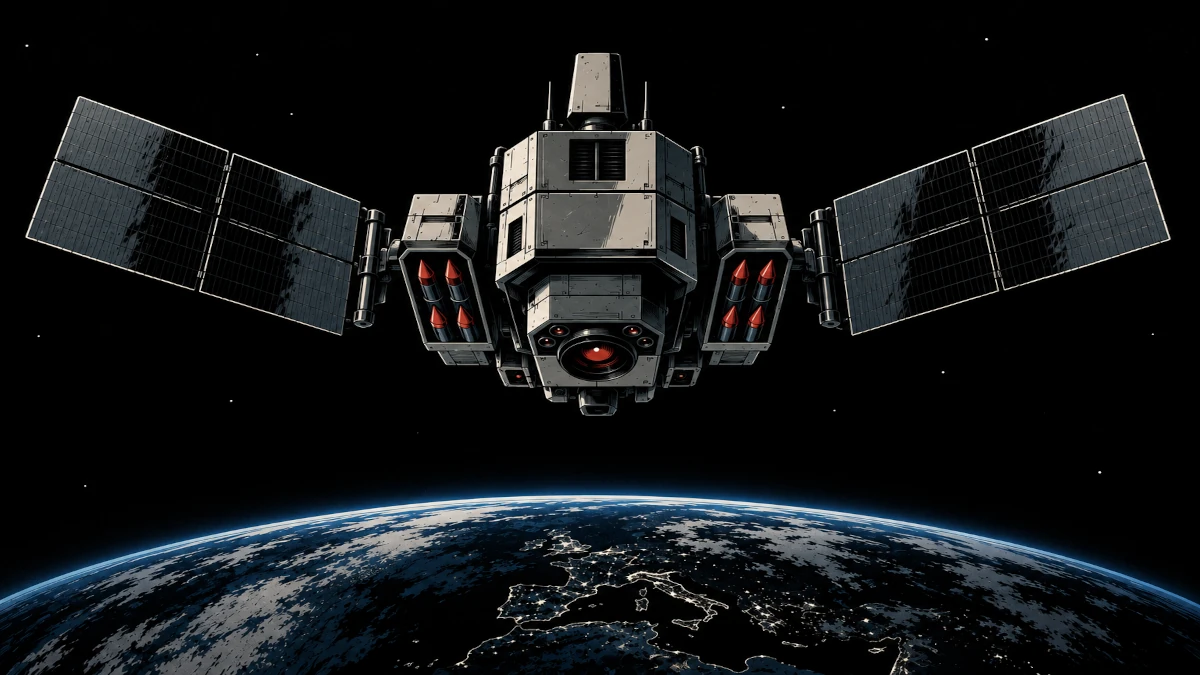
Weapons Already in Orbit
The United States has now publicly acknowledged that it has weapons operating in orbit, but it is refusing to say what those weapons actually are.
Air Force Secretary Troy Meink made the disclosure on September 14 at the Air, Space & Cyber Conference in Maryland, saying the United States has “on-orbit space control weapons capable of defending the Joint Force against hostile adversary action.” The Department of the Air Force described the statement as the first public acknowledgement that the Space Force has deployed weapons in space.
A day later, Chief of Space Operations Gen. Douglas Schiess was even more explicit, saying: “Today, Guardians operate on-orbit weapons that can defend the Joint Force against space-enabled attacks.”
Beyond that, Washington is saying very little.
Officials have not identified the weapons, disclosed how many there are, said where they are orbiting or explained how they work. Meink later declined to elaborate, saying the wording had been carefully chosen and refusing to discuss specifics of the systems.
That leaves an unusual situation. The Pentagon has confirmed the existence of a class of operational weapons without telling the public what those weapons actually do.
And that raises a more interesting question than simply what America has secretly put into orbit.
What, exactly, counts as a weapon in space?
What Counts as a Weapon in Space?
That secrecy matters because a modern space weapon may look nothing like the missiles or bombs people tend to imagine.
The U.S. Space Force itself divides counterspace operations into orbital warfare, electromagnetic warfare and cyberspace warfare. Its published warfighting framework discusses offensive and defensive operations intended to protect friendly space capabilities or deny an adversary the ability to use its own.
At one end are kinetic weapons, systems designed to physically strike, damage or destroy something. An interceptor smashing into another satellite is the obvious example.
At the other end are non-kinetic effects. A military might jam communications between a satellite and the ground, interfere with navigation signals, attack computer networks, dazzle an imaging satellite's sensors or manoeuvre another spacecraft close enough to interfere with it.
None of those possibilities has been confirmed as the purpose of the weapons Meink disclosed. The categories only show how broad the phrase “space control weapon” can be.
There is another common misconception. Weapons are not universally prohibited from Earth orbit.
Article IV of the 1967 Outer Space Treaty prohibits placing nuclear weapons or other weapons of mass destruction in orbit. It does not impose a blanket prohibition on every conventional weapon stationed above Earth. The treaty is much stricter when it comes to the Moon and other celestial bodies, where weapons testing, military bases and military manoeuvres are prohibited.
So a weapon in space does not necessarily have to explode.
It may simply make another system stop working.
When Disruption Comes From Orbit
A recent investigation into GPS interference over Europe showed how signals from a spacecraft can affect systems across vast distances without anything being fired or destroyed.
In a June 2026 research preprint, Zachary Clements, Argyris Kriezis and Todd Humphreys analysed strange Global Navigation Satellite System, or GNSS, interference recorded by ground stations between 2019 and 2026. The work was later brought to a wider audience by Veritasium in its video Something is jamming GPS over Europe. Here's what we found.
The researchers found unusual interference events on 75 separate days, affecting monitoring stations across parts of Europe, Greenland and Canada.
That geographic spread presented a problem.
A transmitter sitting on the ground has to contend with the curvature of the Earth. It cannot easily be visible to receivers thousands of kilometres apart at the same time.
A transmitter high above Earth can.
Using the strength and timing of the signals, the researchers traced one particularly useful event to Cosmos 2546, part of Russia's EKS missile early-warning constellation. They concluded that EKS satellites operating in highly elliptical Molniya orbits were collectively the highly probable source of the wide-area interference events.
A Molniya orbit is designed so that a satellite spends much of its journey high above northern latitudes. From there it has line-of-sight over an enormous area, making the orbit particularly useful for monitoring northern parts of the planet.
There is, however, a crucial distinction.
The researchers identified where the interference was coming from. They did not establish why the Russian satellites were producing it.
The study did not establish whether the emissions were deliberate GNSS interference or a by-product of some other function. The scientific evidence therefore does not show that Russia intentionally operated the EKS constellation as a continent-scale GPS jammer.
But the physical lesson remains.
A spacecraft can produce effects across vast distances without dropping a bomb or hitting another satellite.
And GPS itself illustrates why that matters.
Satellite navigation does more than tell a phone where it is. GPS also distributes extremely precise time. Telecommunications networks use accurate timing to synchronise equipment. Financial systems use precise timestamps. Parts of the electricity sector depend on synchronised timing for monitoring and control. NIST has specifically documented GPS timing dependencies across the financial, telecommunications and electric-power sectors.
Aviation, shipping, logistics, agriculture and emergency services also depend to varying degrees on satellite navigation.
That does not mean a GPS disruption would instantly shut down banks, power grids or aircraft. Critical systems can have backup clocks, alternative navigation methods, redundant networks and procedures for operating through outages.
The point is not inevitable catastrophe.
It is that a system in orbit can potentially interfere with important activities on Earth without anything physically being destroyed.
At the other end of the spectrum, Washington is openly developing something much more recognisable as a weapon.
Golden Dome and the Problem of Putting Interceptors in Orbit
While Washington will not identify the weapons it already has in orbit, it is far more open about another kind of space weapon it is now developing.
The U.S. Space Force established a Space-Based Interceptor programme as part of Golden Dome for America, the planned missile-defence system intended to protect the United States against ballistic, hypersonic and other advanced missile threats.
Space Systems Command says the programme is developing a space-based missile interceptor capability and intends to demonstrate a system integrated with Golden Dome by 2028. Twenty prototype agreements involving 12 companies have been awarded with a combined potential value of up to US$3.2 billion.
These interceptors should not be confused with the classified weapons Meink says are already in orbit. The government discusses the two separately, and the Space-Based Interceptor programme remains under development.
The concept sounds simple enough: place interceptors in orbit, detect a missile launch, then send an interceptor from orbit to engage it.
Orbital mechanics make it considerably harder.
A satellite in low Earth orbit does not hover over one country like a camera fixed to the ceiling. It is continually moving around the planet at several kilometres per second.
That becomes particularly important during the boost phase of an intercontinental ballistic missile, when its engines are still burning and the missile can be an attractive target. The boost phase lasts only a few minutes, meaning an interceptor has to be close enough to reach the missile during that brief window.
An interceptor therefore has to be close enough to the launch area at almost exactly the right moment. Most of the constellation may be somewhere else around the Earth.
The result can be a requirement for enormous numbers of spacecraft.
To illustrate the problem, the Congressional Budget Office modelled a notional missile-defence architecture containing 7,800 space-based interceptors in low Earth orbit. That constellation was designed to provide two interceptor shots against each missile in a raid of ten nearly simultaneous ICBM launches. The CBO estimated its illustrative interceptor layer would cost about US$720 billion to develop, deploy and maintain over 20 years, plus about US$1 billion a year to operate.
That number requires an important warning.
Golden Dome has not announced a constellation of 7,800 interceptors.
The CBO built its own hypothetical architecture because the Pentagon has not publicly released enough detail about Golden Dome's eventual design to calculate its long-term cost. Its broader estimate of about US$1.2 trillion over 20 years similarly applies to the CBO's notional national missile-defence architecture, not a final Pentagon blueprint.
The exercise nevertheless demonstrates the fundamental problem.
Putting a weapon in space is one thing.
Making sure it is in the right place at exactly the right moment is another.
Before Interceptors Came Rods From God
Long before today's jammers and orbital interceptors, one of the most dramatic ideas for warfare from space was brutally simple: drop something very heavy, very fast.
The concept became popularly known as “Rods from God.”
Instead of carrying an explosive warhead, a spacecraft would release a dense metal projectile, often imagined as a large tungsten rod. The projectile's enormous speed would supply the destructive energy when it hit the ground.
The idea is commonly associated with a concept known as Project Thor, developed by science-fiction writer and aerospace researcher Jerry Pournelle, while variants later appeared in genuine U.S. Air Force planning. The service's 2003 Transformation Flight Plan listed “Hypervelocity Rod Bundles” among a range of possible future long-range attack systems.
That makes Rods from God more than pure internet mythology.
It does not make them an operational weapon.
In 2004, then-Under Secretary of the Air Force Peter Teets told the U.S. Senate that Hypervelocity Rod Bundles were not funded programmes but future system concepts, noting that historically most such concepts would never be developed.
The idea also runs into several ugly engineering problems. Heavy rods first have to be launched into orbit. They then have to be in a useful orbital position, manoeuvred toward the target, de-orbited accurately, survive atmospheric re-entry and retain enough control to hit something worth attacking.
Every manoeuvre requires energy. Every propulsion system adds mass. Every extra kilogram must first be launched into space.
A 2024 study of kinetic orbital bombardment concluded that the concept faces major problems with impact geometry, accuracy, mass and cost. Its modelling also found little basis for treating plausible tungsten rods as nuclear-equivalent superweapons.
The contrast with today's programmes is striking. The weapons attracting serious attention now are far more varied than the orbital bombardment concepts imagined decades ago.
The Counterspace Contest
The United States is not preparing for this contest alone, and capabilities already demonstrated by Russia and China offer clues to what conflict in space may actually look like.
China provided one of the clearest demonstrations in January 2007 when it used a direct-ascent anti-satellite weapon to destroy its own FengYun-1C weather satellite in low Earth orbit.
Russia followed with its own destructive demonstration in November 2021, using its Nudol system to destroy the defunct Cosmos 1408 satellite.
Both tests also illustrated one of the worst features of kinetic warfare in orbit: debris.
A destroyed spacecraft does not simply disappear. It becomes thousands of fragments travelling at orbital velocity. Those fragments can threaten military, civilian, commercial and neutral spacecraft long after the original attack or test.
Secure World Foundation's 2026 counterspace assessment says anti-satellite tests by the United States, Russia, China and India have produced 6,904 catalogued pieces of debris, with 2,773 still in orbit.
Those capabilities take many forms. Electronic warfare can interfere with satellite communications, while jamming and spoofing can disrupt or falsify navigation. Cyberattacks can target satellite networks and their ground systems. Lasers can potentially dazzle optical sensors. Spacecraft designed for rendezvous, inspection, refuelling or towing can also demonstrate technologies with potential military applications.
The distinction matters. A satellite capable of approaching another spacecraft is not automatically a weapon.
In a conflict, escalation could begin with jamming or spoofing, move into cyberattacks and interference with data links, then progress toward sensor dazzling, proximity operations or physically disabling a spacecraft. Further escalation could include attacks on ground infrastructure, direct-ascent missiles and ultimately destruction in orbit.
There is a reason militaries may prefer some of those reversible effects. Temporarily denying an adversary's satellite can achieve a military purpose without creating a cloud of high-speed debris that threatens everyone else's spacecraft as well.
A space conflict could therefore begin far more quietly than popular culture suggests.
What Happens in Orbit Does Not Stay There
What happens in orbit would not stay in orbit, because much of modern life now depends on the satellites that military powers are increasingly preparing to defend, disrupt or destroy.
The civilian consequences extend well beyond GPS. Weather forecasting, communications, navigation, agriculture and emergency services all rely to varying degrees on infrastructure in orbit.
Modern militaries are deeply dependent as well.
Satellites provide communications, reconnaissance, missile warning, navigation, intelligence and targeting. Precision weapons can rely on satellite navigation, while commanders increasingly depend on information gathered or relayed through space.
For decades, space primarily helped armed forces fight wars somewhere else. Satellites watched the battlefield, carried communications, warned of missile launches and told weapons where they were.
Now the infrastructure above the battlefield is itself increasingly something military planners expect to protect, contest, disable and, if necessary, destroy.
That shift did not begin with Troy Meink's announcement. Anti-satellite weapons and counterspace programmes long predate September 2026, and no space war has suddenly begun.
What has changed is the openness with which major powers are preparing for the possibility that space itself could become a combat domain.
The United States has told the world its weapons are already up there.
What it still will not tell us is what those weapons are designed to do.