




The Iron Rice Bowl of New Zealand Politics
The State of Politics Ahead of the 2026 Election

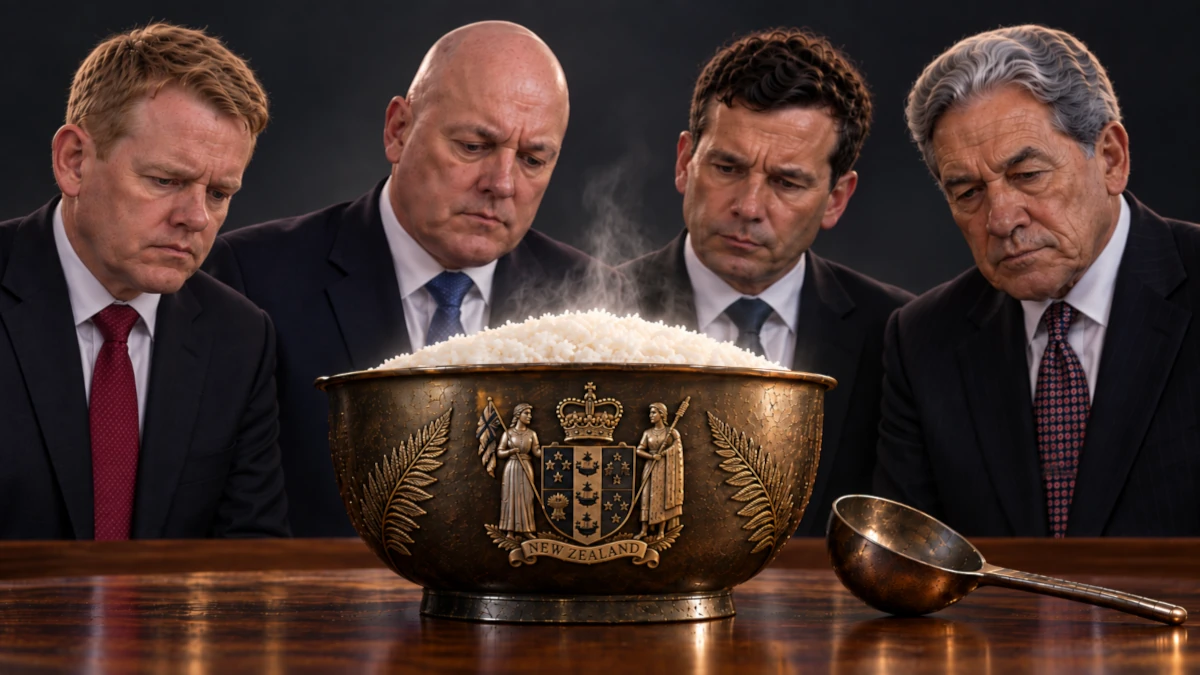
China has an old expression: the “Iron Rice Bowl”. Traditionally, it describes employment so secure that the bowl can never be broken and never quite empties. Governments may change, economies may falter and institutions may fail, but for those holding an Iron Rice Bowl, another meal always seems assured.
New Zealand has developed its own version. Ours is not necessarily a single job for life, nor is there some secret room beneath the Beehive where the country’s permanent rulers gather over tea and gingernuts. It is more subtle than that. It is an ecosystem of institutions, professions, organisations and well-connected people who appear remarkably insulated from the consequences that apply to everyone else.
Governments fall, MPs lose their seats, businesses close, families cut their spending and mortgage holders struggle. Yet somehow the same collection of advisers, consultants, board members, commissioners, bureaucrats, lawyers, academics, bankers, contractors, lobbyists and institutional grandees remain remarkably well fed. They may change titles, departments, boards or employers, but the bowl itself rarely seems to break.
Every three years, we perform our democratic duty. We argue with relatives, watch the televised debates, curse the polls and eventually make it to a ballot box. We cast our party vote and electorate vote, often with the grim pragmatism of choosing the lesser of evils, while hoping this time things might really change for the better.
Elections do matter because things really can change. Taxes can change, regulations can be repealed, ministries can be abolished and governments can change direction on crime, education, energy, Treaty policy and welfare. Yet beneath such politicking sits a chumocracy proving remarkably election-proof.
Senior officials move from one department to another. Former politicians turn up on boards. Lawyers prosper as regulation becomes more complicated. Property speculators prosper when scarcity pushes prices higher. The very people whose supposed expertise has accompanied one failure after another remain remarkably employable.
There is usually another commission, another review, another advisory body, another board appointment, another working group and another consultancy waiting around the corner. Those holding an Iron Rice Bowl are seldom expelled from the system. More often, they are simply recycled through it.
That does not mean every person working in government, academia, banking, law or consultancy is corrupt. Most are not. The problem is not necessarily wicked people. The problem is incentives, and for a small country, New Zealand has created an extraordinary number of people with an incentive to clip the ticket.
Everyone Clips the Ticket
Try doing almost anything substantial in New Zealand and count the hands that appear. Build something and there are consents. Develop something and there are planners, lawyers, consultants, assessments and fees. Run a business and there are regulators, accountants, insurers and administrators.
Government is no different. A programme is created, consultants help design it, contractors implement it, auditors assess it and eventually somebody is hired to review why it did not work. Everyone clips the ticket: councils through rates and consents, banks through lending, lawyers through legal complexity and consultants through tenders. Climate- and Treaty-related policies can create still more layers of advisers, administrators and contractors.
Some of this is necessary. The problem begins when servicing, regulating and middlemanning productive activity grows faster than the productive activity itself. New Zealand can sometimes look like a country passing the same dollar from hand to hand, with everyone deducting a fee along the way.
Eventually, somebody commissions a report into why productivity is so poor — no doubt it will conclude that further consultation is required!
Someone Still Has to Milk the Cow
Beneath all the complexity lies a simple truth: someone has to produce something. A country does not become wealthy by producing invoices alone. It becomes wealthy by producing goods and services people value.
Someone has to milk the cow, cut the timber, write the software, grow the crop, build the house or create something another person is willing to pay for. That matters enormously for a small trading nation like New Zealand.
We import fuel, cars, computers, medicines, machinery and countless consumer goods. We can create more New Zealand dollars domestically, but we cannot print a barrel of oil or a container of imported machinery into existence. Eventually, somebody overseas wants something valuable in exchange.
If demand for New Zealand dollars weakens, imported goods become more expensive. Fuel, technology, travel and machinery all cost more in local terms. Currency movements are complicated, but the basic point is not: borrowing, money creation and domestic ticket clipping cannot substitute indefinitely for productive strength.
Before politicians can redistribute wealth, someone has to create it!
The Permanent Party
Behind the parties we vote for sits what might be called the Permanent Party: the institutions and interests whose incentives survive changes of government.
Governments inherit departments, contracts, laws, court decisions, funding commitments, officials and deeply embedded institutional cultures. Ministers may change, but the machinery beneath them largely remains. That helps explain why election campaigns can sound far more radical than the governments that follow.
The political parties change. The Permanent Party adapts.
The Manager, the Hammer and the Handbrake
National, ACT and New Zealand First arrived promising change, but after nearly three years they have revealed three quite different attitudes towards the Iron Rice Bowl.
Christopher Luxon is a manager. His ascent through National was extraordinarily fast: after a single term in Parliament, he became leader, won the election and became Prime Minister of New Zealand after forming a three-party MMP coalition. Impressive, certainly, although it also said something uncomfortable about a National Party so short of convincing leadership that a former chief executive could walk almost directly from the corporate boardroom to the ninth floor of the Beehive.
Luxon has made some conspicuous changes. Labour’s Three Waters entity model was repealed and replaced by Local Water Done Well, the Māori Health Authority was abolished and government branding now places English names first. These are real changes, though none amount to breaking the Wellington machine. Local Water Done Well still brings regulation and central oversight, Māori health structures remain, and changing the order of words on government letterheads is hardly storming the Winter Palace.
The curious thing about Luxon is that disappointed conservatives cannot really accuse him of selling them on a false prospectus. He was almost painfully candid. He was learning te reo Māori before becoming Prime Minister, National campaigned to liberalise genetic engineering, Luxon supported co-management where it arose from Treaty settlements, and National entered the 2023 election committed to the Zero Carbon Act and New Zealand’s international climate obligations.
Voters looking for a social conservative were inspecting the wrong merchandise. Luxon has always looked more like a modern corporate manager: cautious, consensual and culturally comfortable with much of the establishment he was supposedly elected to reform.
His approach to housing is revealing. While New Zealand remains painfully expensive for younger buyers, Luxon has said he wants “gradual, moderate, consistent” house-price growth, albeit with wages growing faster. It is National’s perennial problem in miniature: campaign against the status quo, inherit it, tidy the desk, change the letterhead and then discover that much of the furniture is rather comfortable.
Luxon does not appear especially interested in reducing the number of Iron Rice Bowls out in the wild — he wants to manage their holders better.
Seymour: The Hammer
If Luxon reaches for the management manual, David Seymour is more inclined to reach for the hammer.
ACT has been markedly more willing to challenge spending, bureaucracy and race-based distinctions in public policy. The Treaty Principles Bill was the clearest example: ACT forced the debate, only to stand alone when National and New Zealand First joined the opposition to defeat it 112–11 at second reading.
Seymour is harder to define than simply “libertarian”. His politics combine market liberalism, individual choice and an uncompromising belief in equal citizenship. He can be admirably clear where others become conveniently cloudy.
But clarity is not always compassion. Seymour drove the End of Life Choice legislation and has backed tougher welfare rules, including restrictions affecting some 18- and 19-year-olds. That stance looks especially severe when youth unemployment is so bleak: in the June 2026 quarter, unemployment was 25.3% among 15- to 19-year-olds and 12.0% among 20- to 24-year-olds, while underutilisation across 15- to 24-year-olds reached 37%.
There is a difference between refusing to infantilise the poor and forgetting that poverty exists. Seymour may be the politician most willing to crack the Iron Rice Bowl, but not every swing of the hammer lands wisely.
Peters: The Handbrake and the Vehicle
Winston Peters plays a different role.
For many New Zealanders bruised or embittered by the COVID years, New Zealand First became a political vehicle when much of Parliament wanted little to do with them. Peters visited the 2022 Parliament protest, pushed for a broader COVID inquiry and, to an extent, kept accountability alive.
That is why calling him merely a handbrake misses something. He gave disaffected voters a vehicle back into Parliament and understood a truth the lanyard class forgot: people remember humiliation!
However, the vehicle does not fit everyone. New Zealand First has offered little immediate relief to younger New Zealanders facing high unemployment, expensive housing and tighter access to Jobseeker support. The problem is not that New Zealand First lacks a destination; it is that too many young New Zealanders are being left on the side of the road while the vehicle drives past.
Labour: Defending a Larger State
Chris Hipkins has attacked National for cutting the Public Service. Yet for all the talk of austerity, the state remains large, expensive and remarkably intact.
Labour’s accusation reveals something more important about Labour itself.
When Labour entered government in 2017, the Public Service employed about 47,000 full-time-equivalent staff. By June 2023, that had risen to more than 63,000. Hipkins has defended much of that growth as necessary, pointing to additional staff in areas such as education, disability support and pandemic preparedness.
That is the real distinction. Labour does not merely tolerate a large Public Service; it generally sees one as necessary to delivering better government.
There is nothing inherently wrong with that argument. A government needs people to run hospitals, schools, regulatory systems and public services. But size is not the same thing as success. More staff, more programmes and more spending still have to produce better outcomes.
And that is where Labour’s relationship with the Iron Rice Bowl becomes uncomfortable.
When an institution struggles, Labour’s instinct is usually to strengthen it, reorganise it or give it more resources. Rarely does the first question appear to be whether the institution itself has become too large, too expensive or simply unnecessary.
That leaves Labour with a question it seldom seems eager to answer:
What is it prepared to cut?
If almost every failing institution deserves another programme, another restructure or another funding increase, then Labour is not promising to break the Iron Rice Bowl.
It is promising to keep it well supplied.
The Government Behind Hipkins
A Labour government would not govern alone. The Greens would push towards greater climate intervention, redistribution and regulation, while Te Pāti Māori would press harder for Treaty-based institutions and collective Māori political rights. Neither is likely to arrive at coalition negotiations demanding a smaller state or fewer publicly funded structures.
More interestingly, the Opportunity Party has become a genuine electoral factor. Opportunity reached 8% in the August 1News Verian poll and 9.5% in an August Roy Morgan poll — enough in either case to enter Parliament comfortably and potentially become critical to the formation of the next government.
Opportunity is also poking at one of New Zealand’s sacred economic cows: property. Its Tax Reset proposes a land-value tax, a Citizen’s Income and compulsory retirement saving, explicitly arguing that capital should be encouraged away from land speculation and towards businesses and productive investment.
New Zealand has spent decades taxing wages and enterprise while allowing housing to become something approaching a national casino. That makes Opportunity unusually interesting. Unlike parties promising merely to distribute the winnings differently, Opportunity proposes changing how the economic game itself is played.
There is, however, reason for caution. Replacing one set of taxes and transfers with another is not automatically the same thing as shrinking the Iron Rice Bowl. A new tax, a universal payment and a compulsory KiwiSaver system could simplify the machinery, or merely rearrange it. Opportunity’s diagnosis of New Zealand’s property obsession may be more honest than most, but the prescription still deserves scrutiny.
The Iron Rice Bowl Test
The real question is not what the parties promise to give us, but who they are prepared to disappoint. Real reform means somebody loses a subsidy, a budget, a contract, a monopoly or an appointment. Political courage is measured less by rewarding supporters than by telling them no.
Can National confront property interests? Can Labour admit that some institutions it expanded simply do not work? Can Opportunity maintain its willingness to disturb the property market when property owners begin objecting loudly? ACT, New Zealand First, the Greens and Te Pāti Māori face their own versions of the same test: can each accept limits when those limits fall on constituencies they value?
Most people live outside the Iron Rice Bowl, where failure has consequences — businesses can lose customers, farmers have to weather bad seasons, workers lose jobs, and young people get priced out of housing. Eventually, the people creating the wealth and pulling the cart start counting the passengers.
The 2026 election will decide who holds the ladle. The real test is whether the Iron Rice Bowl stops being refilled.

