




The Moon Has a New Crater 222 Metres Across
NASA Says the Rare Impact Happened in 2024

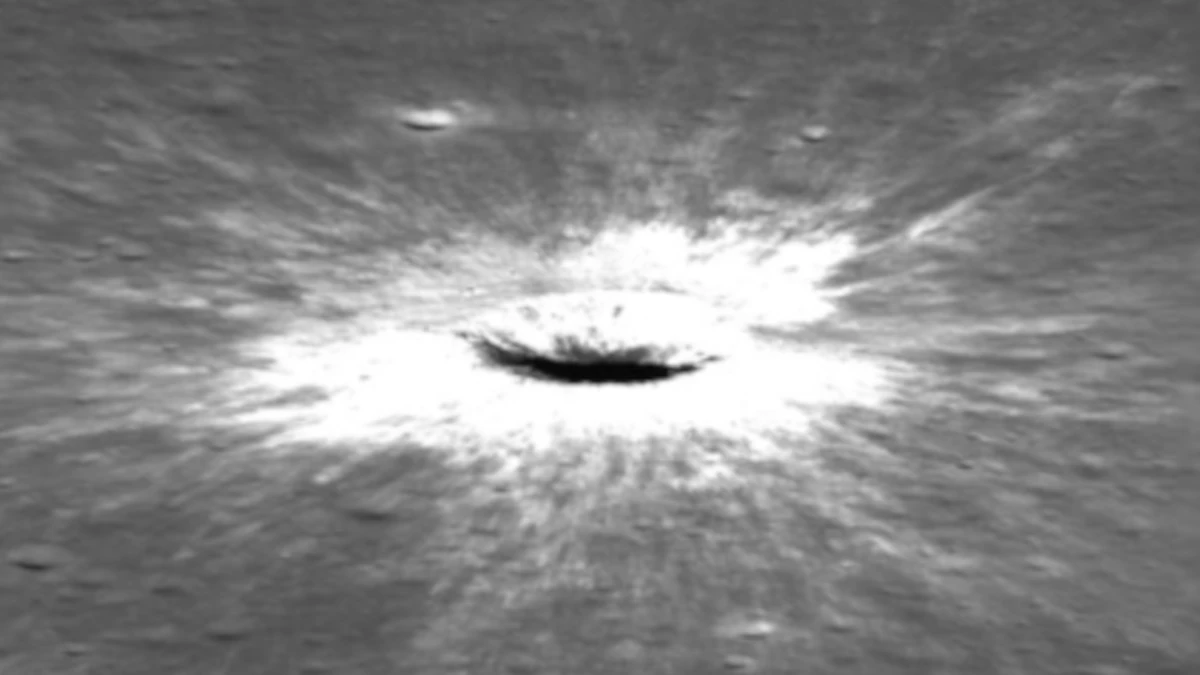
The Moon has gained a new crater, and it is a substantial one.
NASA scientists have identified a recently formed crater measuring more than 200 metres across, created when a sizeable object struck the lunar surface a little over two years ago.
The crater, named McGetchin, measures about 222 metres across and 43 metres deep. Researchers believe it formed when an asteroid or comet, possibly comparable in size to a three- to six-storey building, struck the Moon sometime between April 11 and May 22, 2024.
The collision appears to have gone unnoticed at the time.
The crater was discovered retrospectively in images collected by NASA's Lunar Reconnaissance Orbiter, which has been surveying the Moon for more than 17 years.
The crater was eventually discovered by comparing older and newer images of the lunar surface.
Robert Wagner, an image-processing specialist working with the Lunar Reconnaissance Orbiter Camera team, came across the feature on October 24, 2025, while carrying out a routine check of image data.
The software he was using compares photographs of the same areas of the Moon taken at different times. Features that have remained unchanged largely cancel each other out, while differences appear as bright or dark patches.
McGetchin stood out.
Material thrown across the surface by the impact produced an unusually large debris pattern. Once Wagner recognised what he was looking at, the team obtained much more detailed observations with the orbiter's Narrow Angle Camera.
Those images revealed a crater far larger than the small fresh impacts normally identified during the Lunar Reconnaissance Orbiter mission.
Scientists estimate that an event capable of producing a crater of this size occurs on the Moon only about once every 132 years.
Scientists have debated whether the Moon's craters were volcanic or the result of impacts. Spacecraft observations and the Apollo missions eventually led to impacts becoming the generally accepted explanation for most lunar craters, although the Moon also contains volcanic vents and collapse pits formed by very different processes.
NASA's Diviner instrument, which measures temperatures across the lunar surface, detected a region about seven kilometres wide around McGetchin that becomes roughly 8 to 9 degrees Celsius colder than the surrounding terrain during the lunar night.
Researchers believe the difference comes from the impact churning up and loosening the Moon's surface material, known as regolith. The disturbed soil is less densely packed and does not retain heat as effectively once the area enters the long lunar night.
The disturbance was also detectable much farther from the crater.
Camera observations have identified changes to the surface more than 100 kilometres from McGetchin, despite the crater itself being only 222 metres wide. Researchers say some material was thrown from the impact at steeper angles than had previously been considered typical.
Discoveries such as this help scientists understand one of the processes behind the Moon's familiar pitted appearance.
They have practical value as well.
As NASA and its commercial partners plan additional equipment and operations on the lunar surface, researchers want to better understand how impacts affect the ground surrounding them.
Changes to the density of lunar soil may affect how rover wheels interact with the surface, while material thrown outward from distant impacts could present a risk to equipment expected to remain on the Moon for long periods. NASA's Lunar Reconnaissance Orbiter Camera team says long-lived equipment on the Moon will need to be designed with high-speed particles from distant impacts in mind.
McGetchin is notable for another reason.
NASA describes it as the largest newly formed crater yet discovered in the Solar System.
The crater was named after the late planetary scientist Thomas McGetchin, who became director of what was then the Lunar Science Institute in 1977.
McGetchin was a volcanologist and lunar scientist whose work included research into how material is thrown outward during the formation of impact craters, making his name particularly apt for the newly discovered feature.
The findings were published this week in two papers in Science Advances, one examining the newly formed crater and the other investigating how the impact disturbed and altered the surrounding lunar soil.

