

The Water Cooler Is Back. It Just Has a Comment Section
YouTube Gave Every Niche Its Own Crowd
There used to be a phrase you heard constantly in media: water-cooler television.
It meant the programme everyone would be talking about around the office water cooler the next morning.
Friends. Survivor. The Sopranos. Earlier, Seinfeld.
And yes, whether Ross and Rachel were on a break, somehow became a matter on which normal adults were expected to hold a position.
That was the monoculture.
Not everybody literally watched the same programme, of course. But there were fewer channels, fewer major releases competing for attention and a much better chance that the person sitting beside you had watched what you watched last night.
You could arrive at work with something as vague as, “Did you see it last night?” and there was a decent chance somebody knew whether you meant the show, the match, the scandal or the cliffhanger.
Sometimes it was entertainment.
Sometimes it was sport.
And sometimes, on a terrible day, it was the news.
We are often told the monoculture died.
It's hard to refute. Minus the poetry, this article is already beginning to sound like an ode to something not merely dead, but buried.
Yet part of me isn't convinced.
Perhaps it didn't disappear so much as lose cohesion and begin trying to re-solidify in another form.
I think somebody dismantled the water cooler, scattered the pieces across the internet and gave each one its own Wi-Fi connection.
Switch on the Television
A few days ago marked 25 years since September 11, 2001.
That's a quarter of a century.
If you were old enough to remember that day, you probably remember where you were when you heard.
The office.
The classroom.
The kitchen.
A telephone call from somebody telling you to switch on the television.
That last part interests me.
Not check X.
Not open YouTube.
Not scroll TikTok.
Not wait for somebody to clip the footage, react to the footage, livestream themselves discussing the footage and then upload a 47-minute video explaining why everybody else's reaction to the footage was wrong.
We turned on the television.
And enormous numbers of us were seeing the same images at exactly the same time. There are plenty of things about 2001 we're happy to leave behind, though I do think that kind of collective viewing had one advantage: it gave important events a certain gravitas.
The formal 25th-anniversary commemorations were centred in the United States, but the memory is much wider than that. For people across the world who had a television within reach, 9/11 remains one of those rare events fixed not only by what happened, but by where you were when those images first appeared on the TV set.
2001 Wasn't the Internet of Today
For younger Gen Z, and certainly Gen Alpha, who have only known a world where YouTube is one thumb movement away, here's a small shock.
YouTube didn't exist.
Not some primitive version with ugly buttons.
Nothing.
Its first video, Me at the Zoo, wouldn't be uploaded until April 2005. Google acquired YouTube the following year.
Netflix existed, but it was mailing DVDs to Americans. Streaming wouldn't arrive until 2007.
Fox News was still relatively young, having launched in 1996 under Rupert Murdoch and Roger Ailes.
Even the iPod hadn't arrived yet. Apple unveiled it on October 23, 2001, promising the astonishing possibility of putting 1,000 songs in your pocket.
Try selling that as a premium feature to someone with Spotify today.
A lot of us were still sitting in front of desktop monitors apparently manufactured from the same materials as Soviet apartment blocks.
The internet was here and bandwidth was growing, yet television was still very obviously king.
The Millennials in the Middle
This is where Millennials get interesting.
Before somebody starts a generational war in the comments, I am not suggesting everybody born inside an arbitrary sixteen-year box had the same childhood.
But Millennials occupy a strange place in media history.
A lot of us remember CRT monitors.
Windows 95.
Dial-up.
VHS tapes.
DVD menus.
The first iPods.
Scheduled television.
Being told to get off the internet because somebody needed the telephone.
Then, while we were still relatively young, along came broadband, YouTube, Facebook, smartphones, streaming and the rest of the modern media environment.
We grew up around Gen X's world and then watched the foundations of Gen Z's being poured.
That makes Millennials something of a cultural glue between two completely different ways of consuming news and entertainment.
One side remembers when a television network decided what you were watching at 8:30. The other finds the concept faintly ridiculous.
The Old Media Didn't Die Either
The change isn't as simple as the internet killing television.
Fox News is a perfect example.
Fox didn't collapse.
It won!
In August, Fox News averaged about 2.13 million viewers in primetime, compared with roughly 940,000 for MS NOW and 624,000 for CNN.
The strange part is that Fox kept consolidating its lead inside cable news while cable itself was gradually losing its place at the centre of the television universe.
There wasn't one grand historical moment where everybody stood up, unplugged the cable box and declared the age over.
On-demand viewing grew.
Streaming grew.
YouTube grew.
And gradually the question stopped being whether television was changing and became what, exactly, we still meant by television.
In May 2026, Nielsen found streaming accounted for 48.6% of American television watch-time.
YouTube alone accounted for 13.8% and was the largest individual media distributor Nielsen measured for a third consecutive month.
The internet didn't merely steal television's audience.
At some point, it became television!
Megyn Kelly Crosses the Divide
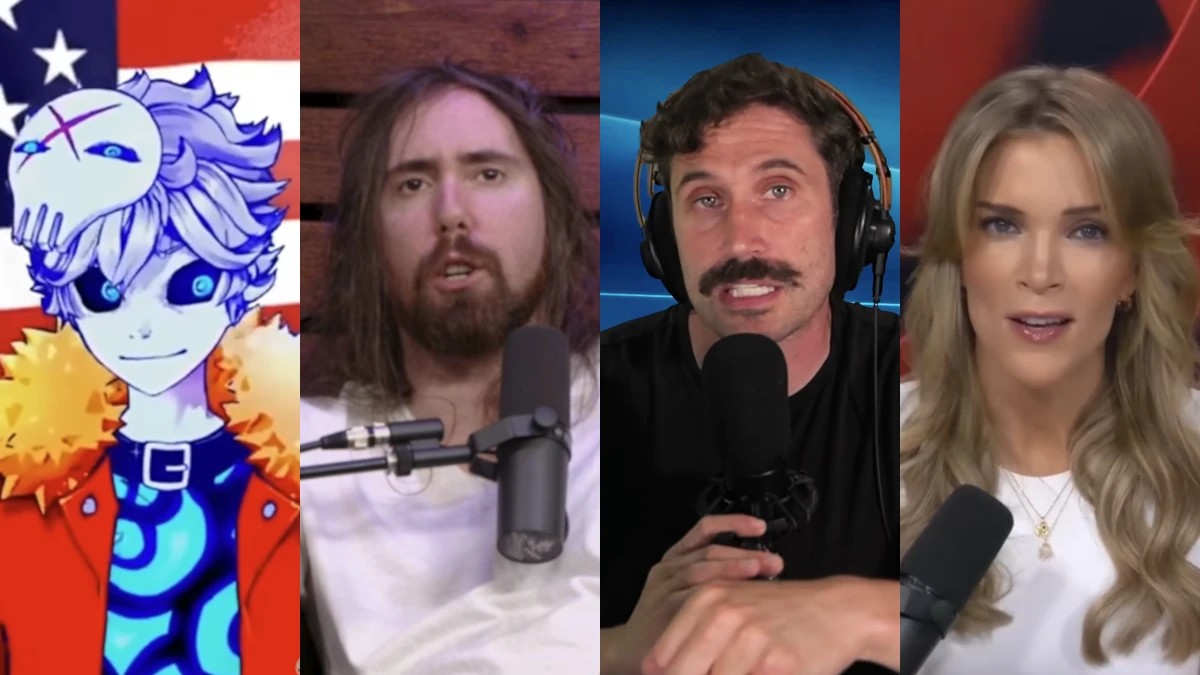
Megyn Kelly is one of the cleaner examples.
She spent years at Fox News, moved to NBC and eventually built an independent operation around The Megyn Kelly Show.
Then came MK Media.
It now includes Spot On with Link Lauren, The Nerve with Maureen Callahan and Next Up with Mark Halperin, distributed across YouTube, podcasts and other platforms.
I still maintain Spot On with Link should have been called The Uplink, but apparently nobody consulted me.
What interests me here isn't Kelly's politics.
It is what she represents.
Twenty years ago, becoming a major television personality generally required somebody to let you through the gates of a major television network.
Now you can leave the network and start building another network yourself.
Joe Rogan is another painfully obvious example, so let's acknowledge him and move along before this becomes yet another article about Joe Rogan.
What interests me even more are the people who never required television in the first place.
The Studio Got Weird
Take Asmongold.
His roots are in gaming, particularly World of Warcraft, but his media world now extends through gaming, internet culture and reaction commentary.
The appeal is almost the reverse of traditional television polish.
Television spent decades building expensive studios to reassure viewers that the person behind the desk was an Important Professional Broadcaster.
A streamer can have hair in disrepair, a room that looks beyond repair, and still pull in an audience many television studios envy.
That's part of the product.
You're not simply receiving information.
You're hanging out.
And perhaps that's where the culture begins to re-solidify: not around the network, but around the person.
Then there is ThePrimeTime on YouTube.
The creator behind it, known online as ThePrimeagen, spent years writing code for Netflix before becoming a full-time creator. ThePrimeTime mixes programming, technology news and reactions to articles and videos; his main channel leans more heavily into engineering itself.
And that matters because reaction culture isn't merely people screaming at anime.
An experienced software engineer can read somebody's article about programming, react to it, disagree with half of it, explain why, disappear down three technical rabbit holes and somehow turn the whole thing into entertainment.
Apparently even software documentation and integrated development environments can become a spectator sport if you put the right larrikin behind the keyboard.
Then things get stranger again.
Nux Taku, who also operates the Nuxanor channel, is a VTuber.
For anyone I have just lost: a VTuber is a creator who performs through an animated digital avatar rather than appearing conventionally on camera.
Nux is not only the man; he's an actual man.
His on-screen face just happens to be animated.
Millions of views later, nobody appears particularly troubled by this arrangement.
His output ranges across current events, anime, gaming, memes, reactions and wider internet culture.
The old television assumption was that audiences needed a recognisable human face sitting behind a desk.
Apparently they don't even require the face to be technically human.
Then We Started Watching People Watch Things
Which brings me properly to the internet's great hall of mirrors: reaction videos.
And this is where things become genuinely interesting.
A film reviewer watches something and tells you what they think. A reaction YouTuber watches something while you watch them watching it.
Somewhere between those formats, criticism became entertainment in its own right, and reaction channels now cover almost everything.
Movies.
Television.
Old television.
Anime.
Games.
Trailers.
Music.
News.
Technology.
Someone can discover a television series made before they were born, upload their first encounter with it and suddenly find themselves surrounded by thousands of viewers who already know every joke that's coming.
On paper, that sounds ridiculous.
Why would I watch somebody else enjoy something I've already watched?
Then you do it.
And suddenly you're waiting for them to reach that scene.
You know the one.
Will they laugh?
Will they spot it?
Will they understand?
Will the thing that worked on you twenty years ago work on somebody seeing it for the first time?
That isn't really about the programme anymore.
It's about sharing the programme.
The Water Cooler Comes Back
This is why I don't think younger audiences abandoned communal viewing.
It's simply re-solidifying in a different form.
YouTube's latest Culture & Trends research found 63% of surveyed online Americans aged 14 to 29 said being interested in the same things as other people made them feel part of something bigger.
Across the broader 14-to-44 group, 69% had watched content from a community they considered niche.
Now, YouTube commissioned that research, so perhaps don't carve the findings into stone tablets just yet.
However, I recognise what it's describing.
Remember school?
There were the sporty kids.
The nerds.
The goths.
The drama kids.
The gamers.
The music obsessives.
And the group that somehow knew everything about everybody before lunchtime.
Culture still works like that.
The difference is that your table in the cafeteria is no longer restricted to people with the same postcode.
Your table can contain a million people.
One is in Texas.
Another is in Tokyo.
Another is in Auckland.
Another is sitting in Birmingham at three in the morning furiously explaining in the comments that everybody else has misunderstood episode seven.
The monoculture didn't exactly vanish.
It fractured into cultures.
And those cultures discovered each other.
Somebody Still Owns the Programme
There is one obvious complication.
Reaction creators are reacting to somebody else's work.
The line has already been fought over in court. In 2017, Ethan and Hila Klein of H3H3 Productions won a copyright case over one of their reaction videos, with a US judge finding that particular video was fair use while explicitly warning that the ruling did not mean every reaction video automatically qualified. Recent copyright fights involving anime reactors show the argument is hardly settled.
A critic shows you enough of a work to talk about it.
A pirate takes the work.
Reaction culture can live somewhere between those two things, depending on how much the creator actually adds.
Copyright lawyers can argue about where the line sits.
The viewers have already decided they like the format.
Maybe We Never Wanted to Watch Alone
Twenty-five years ago, when something mattered, somebody told you to turn on the television.
Today they might send you a link.
Every feed is personalised, with its recommendation algorithm learning a slightly different version of us.
Every niche subdivides until eventually you discover a YouTube channel dedicated to a 1997 video game you were fairly certain only you remembered.
And somehow, we built communities around all those fragments.
Megyn Kelly can build a network without owning a cable channel.
Asmongold can turn sitting at a computer into a media operation.
A former Netflix engineer can make reacting to programming articles entertaining.
Nux can lay it all out as an animated character.
And somebody watching an old television show for the first time can recreate the feeling of watching it with friends for thousands of strangers scattered around the world.
Maybe the old monoculture really is gone.
I'm not sure I miss all or even most of it.
But one thing seems clearer to me now: we never stopped wanting the water cooler; we just stopped needing everybody around it to have watched the same show.
Now we find our own table, and apparently it often seats several million.