




Too Much Stuff and the Kiwi Dream
Why New Zealanders Are So Unhappy

Banal. It’s one of those words junior reporters learn early and then look for excuses to slip into copy, like “assignations” or “zeitgeist”. However, it’s not a bad place to start when you’re trying to describe a slow decline.
New Zealand’s decline didn’t arrive with one dramatic bang. It seeped in through a series of banal, everyday changes: what we bought, where we shopped, what we watched, and what we quietly stopped caring about.
For something emblematic of this decline, one need look no further than The Warehouse.
Once upon a time, that simple red rectangle with its bold white lettering – “The Warehouse: Where everyone gets a bargain” – really did feel like the future. It was arguably New Zealand’s first true big-box store. It had the magic combo: cheap-ish prices, parallel imports, and a money-back guarantee that sounded almost American in its confidence.
For a while, The Warehouse wasn’t just a shop. It was where you went.
Kids bought tennis balls, lollies and cheap sports gear. Teenagers stalked the aisles for candles, dodgy electronics and antiperspirant that smelled like adolescence in a can. Their Boomer parents loaded the trolley with kitchen and garden wares; in went the towels, blankets, storage tubs, and that piece of kit-set furniture – perhaps a computer desk, a CD holder, even an outdoor table and chairs complete with a collapsible sun umbrella. The quiet powerhouse of the business, though, was actually the footwear, and apparel wasn’t far behind.
When New Zealand finally joined the shopping world
Parallel imports started arriving thick and fast in the late 1980s, and suddenly shelves that had once looked sparse started to groan. For the first time, ordinary working families had access to a wide variety of both off-brand and branded goods at prices that felt within reach. Over time – then, as the cliché goes, all of a sudden – people found themselves with more shoes in the wardrobe, more clothes piled in drawers, more towels and linens stacked atop wardrobes, and more kitchen gadgets and homewares filling cupboards and cluttering benchtops, more so than any previous generation had considered normal.
Alongside all this, the 1990s weren’t culturally dead. Universities still felt like places that provided more than just the vestiges of a classical education. Avant-garde clubs flourished, fringe communities staged shows, and students could still appreciate a Dalí or a Waterhouse painting and sit (sometimes even willingly) through productions of The Wasps or Twelfth Night.
New Zealand had, for better or worse, opened up both economically and culturally. Boomer and Gen X parents were raising kids in a country that told them: we’re finally catching up with the world.
And catching up meant stuff.
From sewing and cooking to buying and ordering
There’s another small, telling shift in this era. Home economics classes still taught sewing and cooking – and often took it very seriously indeed. Many Gen X and older Millennials can remember wrestling with a sewing machine or learning how to make a basic white sauce under fluorescent classroom lights.
But outside the classroom, the logic was changing.
Why sew your own clothes when you could pick up something “good enough” from DEKA or The Warehouse for a price that made your labour feel pointless? Why hone your culinary skills when you could take the family to a Pizza Hut all-you-can-eat restaurant and load plate after plate until you physically couldn’t stand?
Slowly, skills that once defined adulthood – making things, mending things, cooking from scratch – were nudged into niches reserved for fashion designers and celebrity chefs, while everyone else was gently guided into their role as customers.
By the time the big-box boom was peaking, a certain idea had settled in: a good life was a full life – not spiritually, but materially, with wardrobes stuffed tight, cupboards packed to the back, and garages so full you could barely get the car in.
Late to the party, early to the hangover
Even though New Zealand arrived late to full-blown consumer capitalism, when it arrived, it went hard.
Big-box stores multiplied. Credit became normal. The Warehouse’s stock price soared. Property began to shift from “home” to “asset class”. The message was simple: modern life is here, and you can buy it.
For Boomers and Gen X, that story arrived at precisely the right time in their lives. They were young adults, then parents, as the tide of products rolled in. They were the ones who brought home the first microwaves, VCRs, Walkmans, stereos and the latest TVs, and later upgraded to home computers, CD players and carefully alphabetised DVD collections.
They didn’t just witness the consumer boom. They embodied it. Their homes became shrines to three decades of upgrades.
Owning things became the language of success: first you got a house and then, if things went well, a bigger house; you started with a car and then traded up to a newer, shinier model; you bought a basic television and eventually replaced it with a bigger, flatter one that dominated the living room; you began with a three-piece lounge suite and ended up with a huge corner couch that took up half the room. Later, as the housing market caught fire, many stepped further into property, buying not just the family home but one or more investment properties – rentals, Airbnbs, the classic Kiwi bach. They didn’t just own the stuff. They owned the containers the stuff lived in.
Stuff wasn’t just what they had. It was how they measured whether life was working.
When stuff turns from comfort into suffocation
The trouble with stuff is that it doesn’t just sit there quietly. It demands care.
Every new purchase needs to be cleaned, maintained, insured and stored somewhere. Every object takes up both physical space in the home and mental space in the mind. Each thing represents money spent in the past and money tied up in the present.
Over time, a house full of things can feel less like a reward and more like a responsibility. You can’t move easily, because the logistics of shifting it all are nightmarish. You can’t downsize without confronting decades of purchase decisions and sentimental attachments. The home becomes a museum, and you’re both curator and caretaker.
Stuff can be comforting and familiar, a record of a life. It can also be suffocating.
But for children of the Boomers and Gen X, the suffocation isn’t just physical. It’s philosophical.
The phone that replaced The Warehouse
If you were born later, you grew up in a very different relationship with “things”.
Walk through an old Warehouse catalogue in your mind and then look at a smartphone. Whole categories of products that once filled aisles are now tucked away as icons on a screen: the digital camera and camcorder that used to live in padded cases, the calculator that once sat on desks, the torch kept in the kitchen drawer for power cuts, the alarm clock on the bedside table, the MP3 player or Walkman and the stereo stack that once took pride of place, the atlas, dictionary and road maps that lined bookshelves, and the paper calendar, diary, address book and notepad that used to live on kitchen benches and in handbags.
Older generations lined these objects up on shelves, plugged them into walls and wrapped them as birthday presents. Younger generations download them. These consumer products have been compressed into an app store.
At the same time, the big physical things that actually matter – housing, some basic furniture, a reliable car – have become more expensive, more precarious and more out of reach.
So Millennials and Gen Z have drawn a different conclusion about happiness. For many of them, the goal isn’t to be so poor that they can’t afford things, but to be so rich that they can afford to live like a poor person. It’s to become secure enough that you don’t have to own very much at all. Not poor as in deprived, but poor as in light.
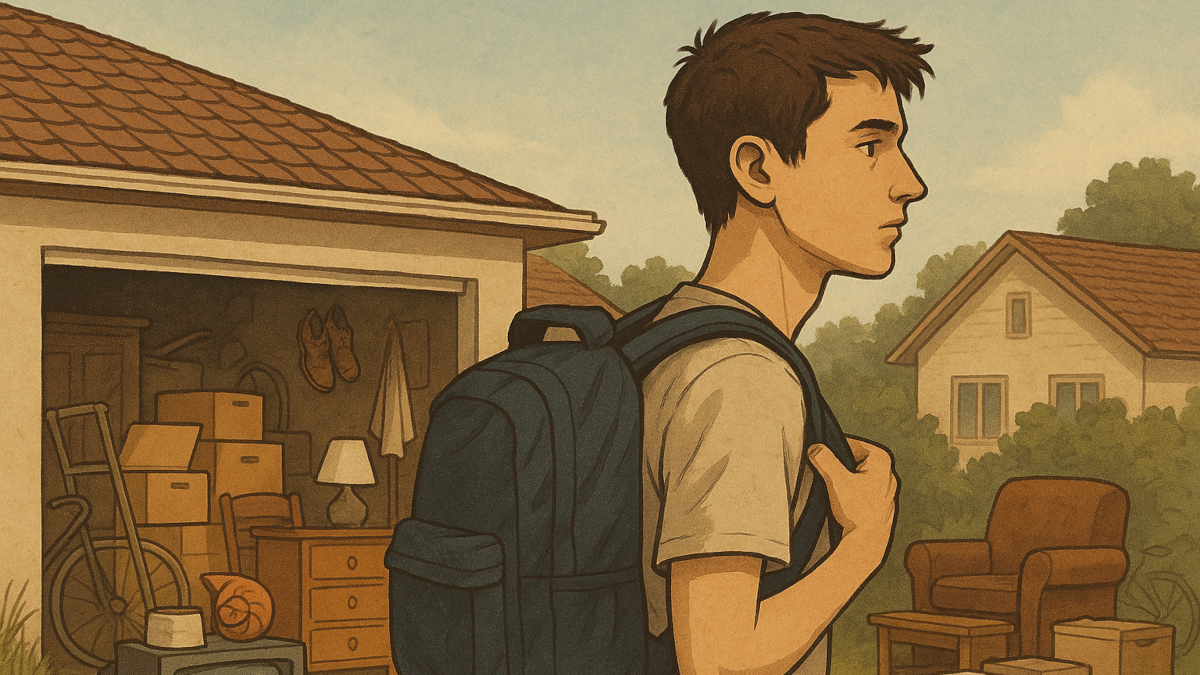
They don’t dream of spending $150,000 on furniture and décor only to haul it from one overpriced rental to another. They’d rather not be anchored to a city they can barely afford to live in. They quite like the idea that most of their meaningful life could fit into a backpack while the rest lives, conveniently and weightlessly, inside a phone.
Freedom, not fullness, is the new aspiration.
The $100 million mansion looks like a full-time job
Then there’s the media diet. Many Boomers and Gen Xers still watch broadcast television, where “aspirational” programming is mostly property porn and lifestyle shows.
You know the script: the camera glides through a $100 million cliff-top mansion with twelve bedrooms, fifteen bathrooms, a ten-car garage, a private cinema, a bowling alley, a gleaming chef’s kitchen, an infinity pool spilling over the edge of the cliff and several impeccably manicured acres of land rolling away into the distance.
We’re supposed to watch with envy and think: imagine living like that.
But to a lot of younger viewers, it looks like stress. All they can see is the reality of fifteen toilets that someone has to clean or pay someone else to clean, rooms that will almost never be used but always need dusting and heating, gardeners and cleaners and chefs and tradespeople who have to be managed and paid, and the relentless drag of power bills, air-conditioning costs, pool maintenance and property taxes.
It doesn’t read as freedom. It reads as overhead. Not today, Satan. Having most of life on a phone starts to sound, well, not that bad at all.
That’s the generational crack: older Kiwis were taught to reach upward into more – more house, more rooms, more things – while younger Kiwis increasingly see “more” as a gilded cage.
Stuck inside someone else’s dream
Here’s the kicker: even as Millennials and Gen Z reject the old dream, they’re still stuck living inside the system built for it.
They might privately value flexibility over permanence, prefer experiences over possessions and crave the lightness of owning less rather than the weight of owning more. Yet they still crash into rental markets that treat them as temporary cashflow rather than people who need homes, into a housing system that treats property primarily as an investment vehicle rather than a social necessity, and into work patterns designed for a world of “one job, one company, one mortgage” despite now living in an economy of casual contracts, gig work and constant churn.
They don’t own the houses. They don’t own the assets. They don’t even get to own the physical gadgets that once brought earlier generations so much excitement, because those gadgets no longer exist as objects – they exist as subscriptions and icons.
So why are New Zealanders so unhappy?
There are plenty of reasons – inequality, healthcare, mental health, isolation, politics. But lurking underneath is this quiet, generational mismatch about what a “good life” even is.
Older New Zealanders are anxious and overburdened by the weight of what they’ve accumulated. Their security is tied up in houses and things, and letting go can feel like erasing their own story and undermining their sense of achievement.
Younger New Zealanders are anxious and exhausted by the feeling that they’re living in someone else’s idea of success – one they can’t afford, don’t particularly want, and don’t know how to escape.
We’re a country that restructured itself around consumerism and property just as the meaning began to leak out of owning things and the cost of shelter exploded.
Boomers and Gen X are still inside the materialism bubble, often watching broadcast slop about mega-mansions and renovations, wondering why their kids don’t seem impressed. Millennials and Gen Z have their lives compressed into a phone and a suitcase, still locked out of the one substantial thing they actually crave: a secure, modest, stable home.
Unhappiness thrives in that gap – between the old promise (“work hard, fill the house, you’ll be fine”) and the new reality (“work hard, own nothing, try not to drown in rent and subscriptions”).
If New Zealand wants to become a happier place, it may need to loosen its grip on houses as trophies and garages as museums of past purchases. It might have to stop confusing having more with living well.
Because for a growing share of young New Zealanders, the dream isn’t an infinity pool on a cliff or a McMansion with fifteen bathrooms. It’s something far smaller, and far braver: a life light enough to move, a home secure enough to exhale, and a future where choosing to own less isn’t a sign you’ve failed – it’s proof you finally got free.

